

Low back pain affects 730 million people worldwide, with numbers projected to exceed 840 million by 2050. In the U.S., 13% of adults experience chronic pain, costing the healthcare system $57.2 billion annually. Research from 2020 to 2026 emphasizes non-pharmacologic, movement-based treatments like exercise, spinal manipulation, and patient education as more effective than medications or imaging for most cases.
Key findings include:
- Exercise therapies (e.g., yoga, Pilates, walking, tai chi) improve pain and disability, with yoga showing the largest impact (SMD = -1.97).
- Early patient education and tailored programs like STarT Back reduce work absences by 50%.
- Walking programs cut recurrence risk by 28% and extend pain-free periods.
- Combining chiropractic care with self-management improves outcomes, reducing disability by 50%-67% in trials.
Movement, consistent activity, and ergonomic adjustments are critical for prevention and recovery. Professional support, such as chiropractic care, enhances these efforts, addressing both pain and its root causes.
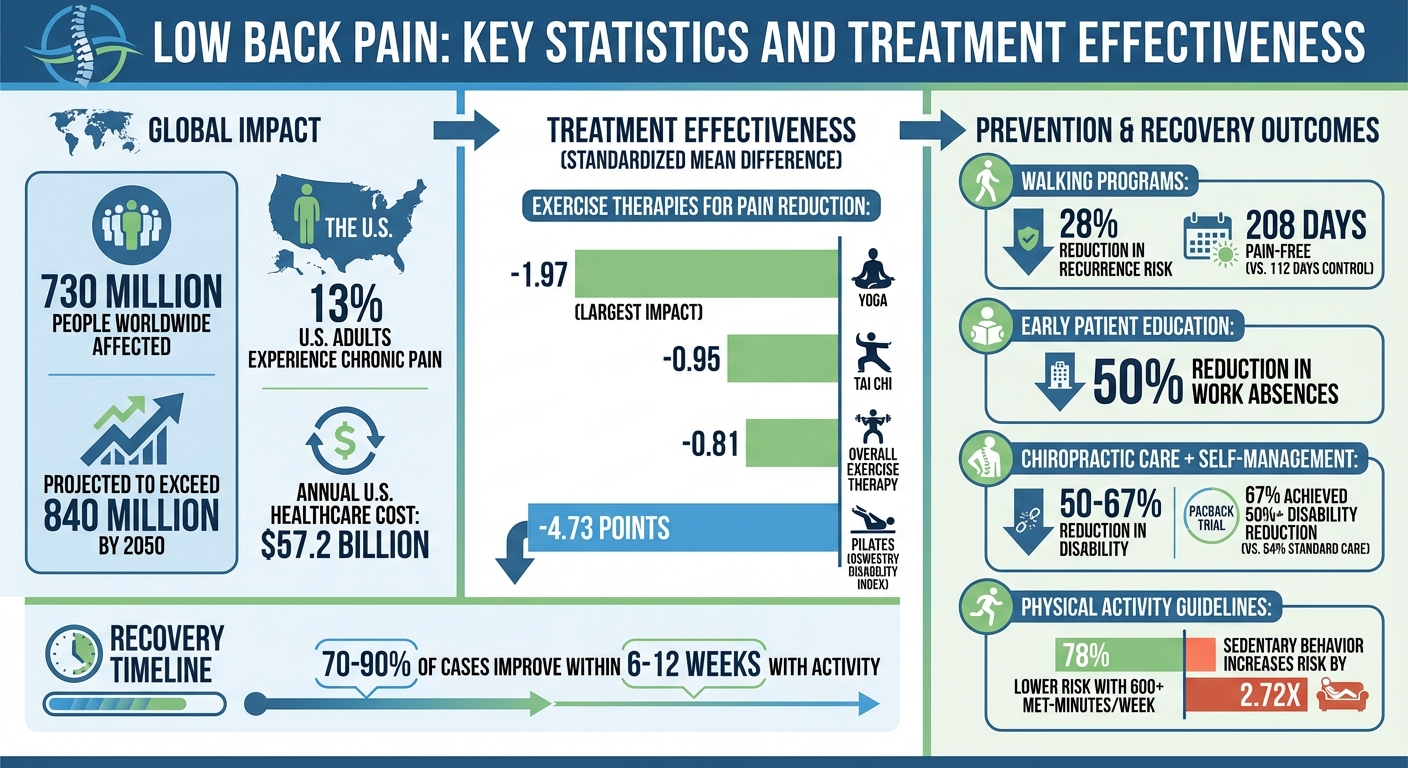
Low Back Pain Statistics and Treatment Effectiveness: Research-Backed Data
Why should we care about low back pain? Global trends and perspectives
sbb-itb-ed556b0
Self-Management and Chiropractic Care: What the Research Shows
The PACBACK trial is one of the largest studies on low back pain treatment, conducted between November 2018 and May 2023, with follow-up scheduled for June 2024. This randomized clinical trial included 1,000 adults dealing with acute or subacute low back pain who were at moderate to high risk of developing chronic disability. It compared two approaches: standard guideline-based medical care and clinician-supported biopsychosocial self-management.
The PACBACK Trial: Self-Management Results
The results of the PACBACK trial highlighted the effectiveness of clinician-supported biopsychosocial self-management. Patients in this group, who received care from physical therapists and chiropractors over an eight-week period, achieved better outcomes. They reported a 12-month mean disability score of 4.7, with 67% experiencing a reduction of at least 50% in disability. By contrast, those in the standard care group had a mean score of 5.9, with only 54% reaching the same level of improvement [4].
This approach focuses on equipping patients with tools to manage physical, psychological, and social aspects of their condition. As Steven George, PhD, Professor of Orthopaedic Surgery at Duke University, puts it:
"The most durable gains for back pain often come from equipping patients with skills for self-management – not just prescriptions" [5].
How Chiropractic Adjustments Provide Long-Term Relief
When chiropractic adjustments are added to self-management strategies, the benefits extend even further. While spinal manipulation alone didn’t significantly outperform standard medical care in the PACBACK trial, combining it with supported self-management showed promising results. This combined approach led to a mean disability score of 4.8, with 65% of patients experiencing at least a 50% reduction in disability [4]. These findings suggest that combining chiropractic care with education and self-management strategies delivers the best outcomes.
Additional evidence supports these findings. A 2026 study involving 750 U.S. active-duty military personnel revealed that adding chiropractic care to standard treatment improved disability scores by 2.2 points at 12 weeks and 1.7 points at 52 weeks. It also reduced sleep disturbances by 3.6 points at 52 weeks [6]. These improvements go beyond pain relief, enhancing overall quality of life for patients.
Daily Walking and Exercise for Prevention
How Walking Prevents Low Back Pain
Walking is a powerful way to reduce the risk of recurring chronic low back pain. In September 2024, a study led by Mark Hancock at Macquarie University in Sydney, Australia, tracked 701 adults who had recently recovered from non-specific lower back pain. Participants in the treatment group followed a personalized walking program, gradually building up to 30 minutes a day, five days a week, over six months. The findings, published in The Lancet, revealed that this group was 28% less likely to experience a recurrence of pain and went an average of 208 days between episodes, compared to just 112 days for the control group [7].
Walking works by strengthening the muscles, vertebrae, and discs that support the back, while also improving blood flow, which promotes tissue healing. It provides a gentle, low-impact challenge to the spine and helps deliver essential oxygen and nutrients needed for recovery. As Mark Hancock puts it:
"Our body heals beautifully, but it needs a good environment to heal, and the healing environment is movement" [7].
The secret lies in consistency, not intensity. You don’t need to power walk or push yourself too hard – what matters most is the total amount of movement. Studies have consistently shown that walking benefits a wide range of patients [3]. Additionally, walking helps to break the cycle of fear-avoidance behaviors, which can lead to inactivity and muscle stiffness. For even better results, combining walking with functional training can provide added support and mobility for your back.
Adding Functional Training to Your Daily Routine
While walking is an excellent starting point, pairing it with functional training exercises can take your back strength and mobility to the next level. Exercises like Pilates and core-stability training have proven effective in reducing functional disability. For instance, Pilates has shown a mean improvement of -4.73 points on the Oswestry Disability Index [3]. These types of exercises target deep muscles such as the transversus abdominis and multifidus, which are crucial for spinal support.
At Portland Chiropractic Group, combining personalized functional training with walking routines has been a successful strategy for improving back stability and preventing future pain episodes. This approach includes education on pain management alongside exercises tailored to individual physical needs. Research supports this method, showing that combining exercise with education can lower the risk of low back pain episodes by 27% to 45% [8]. Start with manageable movements and gradually increase intensity to build strength over time.
Tai Chi and Yoga for Back Pain Relief
If walking or functional training doesn’t feel like the right fit for you, Tai Chi and yoga are excellent options for managing chronic low back pain. These practices align with the idea of using active, movement-based strategies to address pain.
Tai Chi for Pain Management
Tai Chi, a traditional Chinese practice, focuses on concentration, controlled breathing, and physical relaxation. According to recent reviews, it’s one of the most effective exercises for reducing chronic non-specific low back pain. Studies show it significantly alleviates pain (SMD = –0.95), ranking it alongside walking and Pilates as a top choice for pain relief [3].
A 10-week Tai Chi program, consisting of 18 sessions lasting 40 minutes each, led to notable improvements in pain and disability [3]. Even shorter programs – just six weeks long – have been shown to reduce pain and improve balance and gait in older women [3]. Beyond easing pain, Tai Chi strengthens muscles, enhances coordination, and supports neuromuscular function, which is particularly beneficial as we age [2][3]. For the best results, aim for three 60-minute sessions per week, with Chen-style Tai Chi Chuan highlighted for its neuromuscular benefits [3].
Other mindful movement practices, like yoga, can also play a significant role in improving back health.
Yoga for Specific Spinal Conditions
Yoga complements Tai Chi by offering a well-rounded approach to spinal care. It strengthens the muscles that stabilize the spine, improves lumbar mobility, and activates the parasympathetic nervous system, promoting relaxation [2][11]. Among six exercise therapies analyzed in a meta-analysis, yoga had the largest effect size (SMD = –1.97) for treating low back pain [2].
"Yoga demonstrates its ability to decrease pain along with disability and medication needs while boosting spinal flexibility and quality of life for patients with CLBP according to research." – BMJ Open Sport & Exercise Medicine [11]
Yoga has also been found particularly helpful for managing symptoms of lumbar disc herniation [10]. For example, a 16-week Iyengar yoga program in the U.S. significantly improved pain and functional outcomes for people with mild chronic low back pain [3]. Research suggests shorter sessions (30 minutes or less), performed more than four times a week for at least four weeks, are the most effective [2]. However, since spinal conditions can be complex, professional guidance is recommended to ensure exercises are performed correctly [11].
Ergonomics and Lifestyle Changes for Back Health
Exercise is just one piece of the puzzle when it comes to maintaining a healthy back. Your daily habits and workspace setup also play a big role. Research now highlights the importance of movement variety and regularly changing positions over striving for one "perfect posture" to support spinal health [9].
Workstation Design and Movement Breaks
Your office setup can either help or hurt your back. A workspace with adjustable lumbar support, proper seat height, and armrests that maintain the natural curve of your lower back can reduce the strain of staying in one position too long. Standing desks are another great option, letting you switch between sitting and standing to ease the pressure of prolonged sitting [9].
A study conducted by Haidong Gu and Jiyue You in February 2026, which involved 472 adults in Binhai County, China, found that sedentary behavior increased the risk of chronic low back pain by 2.72 times. However, participants who followed the physical activity guideline of at least 600 MET-minutes per week lowered their risk by about 78% [12]. Even something as simple as breaking up long periods of sitting – defined as two or more hours without moving – can make a difference [12].
For optimal results, aim for 90 to 120 minutes of walking each day. Short walks of 10 minutes each can add up to significant benefits, as the total amount of movement matters more than the speed [9].
Wearable Posture Devices: What the Evidence Says
Wearable posture devices are gaining popularity as tools to encourage healthier movement habits. These devices provide real-time feedback, often through vibrations, to alert you when you’re slouching. This helps you adjust your posture and avoid staying in one position for too long [9].
"Rather than viewing wearables as a cure in themselves, they’re best used as tools to support healthy habits and reduce prolonged static postures." – National Spine Health Foundation [9]
Research backs up the benefits of these devices. In a randomized controlled trial, patients using real-time biofeedback during exercise saw significantly greater increases in lumbar multifidus muscle size at 8 weeks (mean difference of 0.81) and 20 weeks (mean difference of 1.61) compared to those who exercised without feedback [14]. Additionally, sensor-based motion assessments have demonstrated over 85% accuracy in distinguishing between individuals with low back pain and those without [13]. These tools work well alongside professional treatments to promote overall back health.
Chiropractic Care and Additional Therapies at Portland Chiropractic Group

While ergonomic changes and movement habits are essential, there are some back issues that require professional care. Portland Chiropractic Group in Oklahoma City, Oklahoma offers services like chiropractic adjustments, the Graston technique, and dry needling. These treatments are part of personalized, evidence-based plans designed to support your spinal health and enhance the benefits of your daily habits.
Conclusion
Recent studies highlight that staying active is one of the most effective strategies for managing low back pain. Activities like daily walking (90–120 minutes), yoga, Tai Chi, and functional training have proven to be more beneficial than trying to maintain a single, static posture. In fact, research shows that 70–90% of low back pain cases improve within 6–12 weeks when activity is prioritized over bed rest [1].
Consistent with earlier findings, non-pharmacologic treatments – such as exercise, spinal manipulation, and lifestyle changes – are now widely recognized as the first choice for managing chronic low back pain [1]. Among these, exercise therapy stands out, showing a notable reduction in pain levels (SMD = -0.81). Yoga, in particular, has demonstrated the most significant impact, with an effect size of -1.97 [3][2].
Combining active self-care with professional support tends to deliver the best results. Spinal manipulation, for example, can improve proprioception – the body’s ability to sense joint position and maintain balance – which is often compromised in individuals with chronic back pain [15]. When combined with ergonomic adjustments, regular movement breaks, and structured exercise routines, these approaches address both the immediate discomfort and the root causes of pain.
Portland Chiropractic Group in Oklahoma City provides care rooted in evidence, offering services like chiropractic adjustments, the Graston technique, dry needling, and functional training. If you’re dealing with persistent back pain or looking to prevent future episodes, consulting a professional can help you find the right combination of treatments and lifestyle changes to support your recovery and long-term health.
FAQs
When should I see a chiropractor for low back pain?
If approaches like regular exercise, improving ergonomics, or making lifestyle changes aren’t easing your symptoms, it might be time to explore chiropractic care. Chiropractors can address ongoing or intense pain, restricted movement, or neurological issues. This form of care is particularly effective for managing back pain and improving overall mobility.
How do I know which exercises are safest for my back?
When it comes to protecting your back, the key is to focus on gentle, controlled movements that suit your specific needs. A few commonly suggested exercises include:
- Knee-to-chest stretches: These can help relieve tension in your lower back and improve flexibility.
- Pelvic tilts: Great for strengthening your core and supporting your spine.
- Cat-camel stretches: These promote mobility and reduce stiffness in your back.
Start with low-impact exercises and pay close attention to how your body responds. If you experience significant discomfort or pain, stop immediately. It’s always a good idea to check with a healthcare professional or physical therapist to ensure these movements are safe and suitable for your back health.
What are the warning signs my back pain isn’t “normal”?
Signs that your back pain might be more than just a common ache include symptoms like pain that radiates to other areas, noticeable muscle weakness, numbness, or discomfort that doesn’t improve with standard treatments. If your pain is severe, worsening, or accompanied by these alarming symptoms, it could point to a more serious issue. In such cases, it’s crucial to consult a healthcare professional without delay.

Comments are closed