


Spinal discs are not as fragile as once thought. Research shows most disc changes seen on MRIs don’t cause pain, and the body has a natural ability to heal. Movement, hydration, and a healthy lifestyle are key to maintaining disc health and reducing back pain. Avoiding excessive rest and fear of activity can accelerate recovery, while targeted exercises and professional care can strengthen the spine and improve function.
Key takeaways:
- Disc degeneration is common but often painless.
- Movement helps discs heal by improving nutrient flow.
- Lifestyle factors like hydration, weight management, and quitting smoking support spinal health.
- 90% of herniated discs improve without surgery within three months.
- Focus on function and symptoms, not MRI results.
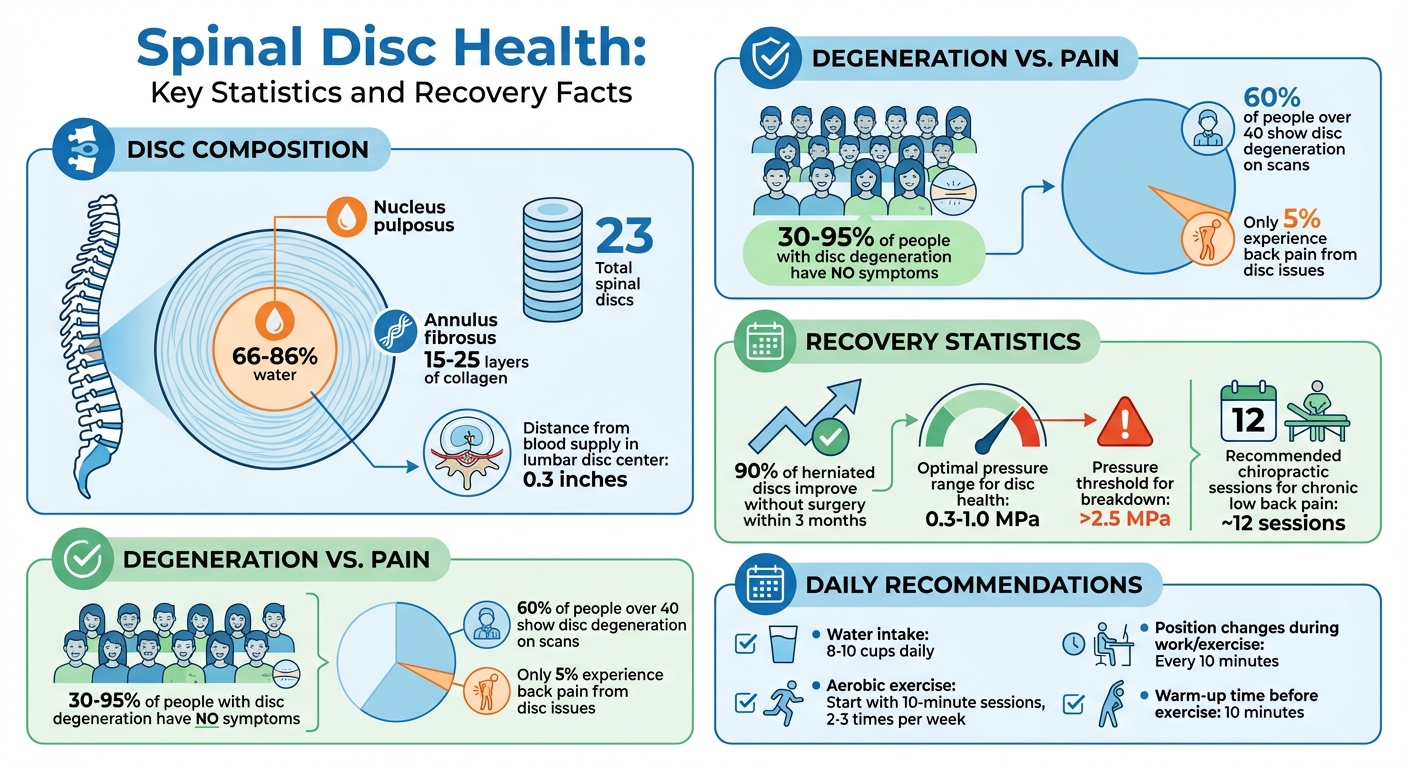
Spinal Disc Health: Key Statistics and Recovery Facts
The Science of How Discs Adapt
How Spinal Discs Work
Spinal discs are made up of two main components: the nucleus pulposus and the annulus fibrosus. The nucleus pulposus, which is 66–86% water, acts like a gel-filled cushion, while the annulus fibrosus consists of 15–25 layers of collagen that form a tough, fibrous outer ring [7]. Together, these 23 discs play a critical role in maintaining the structure and function of your spine [14].
The nucleus pulposus works like a water balloon, using its high water content to evenly distribute pressure across the vertebrae. When you bend, twist, or lift, it spreads the load to prevent stress from concentrating in one spot [7]. Meanwhile, the annulus fibrosus acts like a protective cage, with its collagen fibers arranged at roughly 60° angles to resist the forces of twisting, bending, and stretching [7].
What’s fascinating is how adaptable these discs are. For instance, if the nucleus pulposus dries out and loses its cushioning ability, the annulus fibrosus can step up, expanding to handle more of the load [7]. This dynamic design allows the spine to respond to various stresses, setting the stage for how it adjusts under mechanical pressure.
How the Body Responds to Mechanical Stress
Spinal discs are highly responsive to mechanical forces, thanks to TRPV4 receptors that detect pressure changes. These receptors trigger the production of extracellular matrix when the pressure is within an optimal range of 0.3–1.0 MPa. However, when pressure exceeds 2.5 MPa, the matrix begins to break down [10]. This delicate balance underscores the disc’s ability to adapt to stress.
"Spinal degeneration and healing are both mediated by the activity of cells which are acutely sensitive to their local mechanical environment."
Since adult spinal discs are the largest avascular structures in the human body, they rely entirely on movement for nutrient delivery [11]. In the center of a lumbar disc, cells can be as far as 0.3 inches from the nearest blood supply [12]. Movement creates a "pumping" effect, where mechanical loading generates fluid flow, carrying glucose and oxygen from the vertebral endplates into the disc’s core [11][8]. This process highlights how daily activities directly impact disc health.
What Influences Disc Health
Hydration plays a major role in maintaining healthy discs. Throughout the day, discs lose water as they bear the weight of the body, but they rehydrate during rest [13]. Drinking 8–10 cups of water daily helps maintain the osmotic pressure necessary for discs to draw in water, keeping them plump and capable of withstanding compression [15][16].
Movement is equally important. Regular physical activity promotes nutrient flow and waste removal, while a sedentary lifestyle can cause this process to stagnate [11][16]. Even posture matters – proper spinal alignment ensures weight is evenly distributed, allowing discs to absorb nutrients and fluids more effectively [15].
Other factors, like smoking and obesity, can negatively affect disc health. Smoking reduces blood flow, cutting off the supply of essential nutrients needed for repair [13]. Obesity increases the strain on the spine, speeding up wear and reducing the discs’ ability to absorb shock [16][1]. On the flip side, a diet rich in Vitamin C (for collagen production), Vitamin D, calcium, and omega-3 fatty acids can help reduce inflammation and maintain the structural integrity of the discs [13][15].
The key to long-term disc health lies in balancing anabolic (building) and catabolic (breaking down) processes. While moderate mechanical stimulation encourages the production of the extracellular matrix, excessive strain can lead to tissue damage. This creates a "vicious cycle" where overloading breaks down the water-binding matrix, leaving the disc less capable of handling stress [8][2]. By managing these factors, it’s possible to support the discs’ natural ability to adapt and shift from degeneration to resilience.
How to Support Disc Health
Chiropractic Care for Disc Function
Chiropractic care provides a non-surgical, hands-on approach to managing disc-related pain and improving spinal function. Techniques like high-velocity, low-amplitude spinal manipulation (HVLA-SMT) are designed to restore movement, reduce pain, and improve overall function [17]. When paired with spinal mobilization, these methods can offer benefits that go beyond simply relieving pain [19]. Studies have shown that patients undergoing spinal manipulation are less likely to need opioids or surgery [17].
At Portland Chiropractic Group, care plans are tailored to each patient, combining spinal adjustments with other therapies. These include the Graston technique for soft tissue treatment, dry needling for muscle issues, and shockwave therapy to aid healing. Additional tools like low-level laser therapy, interferential current, and transcutaneous electrical nerve stimulation (TENS) are used to address chronic musculoskeletal pain [18]. For individuals with herniated discs, about 90% experience improvement within three months through non-surgical treatments. These treatments often begin with passive pain management and progress to active care, such as exercises and stretching, to build long-term strength and resilience [3][17]. This progression lays the groundwork for exercises that support and strengthen the discs.
Exercises That Strengthen Disc Health
Targeted exercises play a key role in supporting the spine, particularly by engaging the muscles that compensate when discs and ligaments are under stress [21][22]. Without this muscular support, the spine can struggle under as little as 20 lbs (9 kg) of pressure [22].
Core stabilization exercises are essential. Movements like the Bird Dog and planks activate muscles such as the erector spinae, transversus abdominis, multifidus, and pelvic floor. These muscles help maintain a neutral spine and reduce instability between segments [21][22].
Aerobic activities, like walking or using a stationary bike, also strengthen the paraspinal muscles without putting undue strain on the spine. Starting with 10-minute sessions two to three times a week, along with a 10-minute warm-up to increase blood flow, is an effective and safe way to begin [21]. Flexibility exercises like the Cat-Cow stretch and hamstring stretches improve range of motion and reduce small, repetitive movements that can lead to disc-related pain [20][21]. If any exercise causes pain, stop immediately and consult your healthcare provider [21][22].
Daily Habits for Long-Term Disc Health
Beyond chiropractic care and exercise, daily habits can help maintain disc health over time. Because spinal discs don’t have their own blood supply, they rely on movement to circulate nutrients through the vertebral endplates [6][20]. Staying active throughout the day – avoiding long periods of sitting or standing and regularly changing positions – helps prevent increased pressure on the discs [4][20][21].
Hydration is another critical factor. Drinking 8–10 cups of water daily supports nutrient circulation and helps the nucleus pulposus – the gel-like center of the disc – function as an effective shock absorber [20][23]. Pair this with an anti-inflammatory diet to further promote disc health [6].
Managing weight is equally important. Carrying less weight reduces the stress on the lumbar spine, where most herniated discs occur [3][4]. Low-impact activities like swimming or water therapy can strengthen the back muscles without placing too much strain on the spine [4][6]. Quitting smoking is also crucial, as smoking disrupts nutrient delivery to the discs and increases sensitivity to pain [4][5].
When lifting, always maintain a neutral spine to minimize stress on the discs. Avoid twisting or bending forcefully, as most sciatica symptoms result from repetitive strain rather than a single heavy lift [3][23]. Strengthening the core and improving hip flexibility can ensure that larger muscle groups provide the necessary support for the spine [6].
Moving Past Fear and Avoidance
Getting Comfortable with Movement Again
Fear of movement can create a frustrating cycle. When you start believing your back is fragile, your natural reaction is to stiffen your trunk to protect it. But this often backfires, increasing muscle tension and spinal stress, which can actually make the pain worse instead of preventing it [24].
Avoiding activity only adds to the problem. The deep spinal muscles that stabilize your back begin to weaken, creating a snowball effect of weakness and dysfunction [21]. Extended rest – anything beyond a day or two – can restrict blood flow and slow down the healing process [6]. As Dr. Andrew Cole, a physiatrist, explains:
"Movement heals – immobilization hurts. Resting too much usually slows your healing."
- Dr. Andrew Cole, Physiatrist [6]
To break this cycle, start with gentle, low-impact activities like walking, water therapy, or using a stationary bike. These exercises help rebuild your confidence without putting too much strain on your spine. It’s also important to change positions frequently – every 10 minutes or so during exercise or work – to avoid overloading specific muscle groups [21]. Gradual exposure through a carefully guided physical therapy program can help you ease back into daily activities and restore trust in your spine’s strength [6]. This approach lays the groundwork for understanding how your discs can heal.
Understanding How Discs Actually Heal
A key part of recovery is understanding what MRI findings really mean. For example, between 30% and 95% of people with intervertebral disc degeneration have no symptoms at all [5]. In fact, nearly 60% of people over 40 show some signs of disc degeneration or narrowing on scans [21], but only about 5% actually experience back pain because of it [4].
Dr. Cole highlights an important perspective:
"Focus on your ability to function and symptoms, not the scan. Your recovery depends more on how you move and treat the inflammation than the MRI report."
- Dr. Andrew Cole, Physiatrist [6]
Here’s the good news: up to 90% of herniated discs improve over time with nonsurgical treatments like physical therapy and posture improvement [6]. Your body has an incredible ability to reduce the inflammation causing disc pain [6].
Misconceptions, such as the idea that lifting with a slightly rounded back is always harmful, can trigger unnecessary fear – even in people without back problems [24]. Shifting your focus from what the MRI shows to what you’re capable of doing can help break this cycle of fear. With a better grasp of how discs heal, working with a supportive healthcare provider becomes a crucial step.
Working with a Healthcare Provider You Trust
Understanding your spine’s ability to adapt is only part of the equation. True recovery often hinges on finding a healthcare provider who can address both the physical and psychological obstacles in your way. Discs are resilient, and a provider who understands this can guide you through overcoming fear and restoring function.
A good provider will help you recognize "yellow flags", such as fear-avoidance beliefs, catastrophizing, and kinesiophobia. These psychological factors often predict long-term disability better than physical findings.
Patient-focused care looks beyond the specific disc issue to address overall spinal health and body function, including core strength and hip mobility. This holistic approach ensures that recovery isn’t just about masking symptoms – it’s about tackling the root cause of your pain [6]. A trusted provider will guide you through gradual loading exercises, targeted stabilization, and lifestyle changes tailored to your needs. This empowers you to take charge of your recovery, leaving you feeling capable rather than helpless.
sbb-itb-ed556b0
Conclusion
What to Remember
Your spinal discs are more than just static structures – they’re responsive, adaptable tissues that can handle the demands you place on them. Shifting your perspective from seeing disc changes as inevitable decline to recognizing their potential for resilience can completely change how you approach spinal health.
Here’s something worth noting: between 30% and 95% of people with disc degeneration visible on imaging experience no pain at all [5]. This means that an MRI result doesn’t dictate your destiny. In fact, about 90% of herniated discs improve within three months through non-surgical methods [3]. Movement plays a big role in this recovery process, as it helps deliver nutrients and reduces inflammation. Simple habits like walking, maintaining a healthy weight, quitting smoking, and avoiding prolonged sitting can make a real difference in how your spine adapts over time [4].
The bottom line? Replace fear with informed action. Your spinal discs are part of a bigger system that includes your core strength, hip mobility, and overall movement patterns. By focusing on the whole picture rather than fixating on imaging results, you give your body the best chance to recover, adapt, and thrive.
How Portland Chiropractic Group Can Help

This forward-thinking view of disc health shapes everything we do at Portland Chiropractic Group.
Located in Oklahoma City, Oklahoma, we offer evidence-based care designed to support your spine’s ability to adapt and recover. Research indicates that around 12 sessions of spinal manipulation deliver the best results for chronic low back pain and improving functional ability [26]. Our approach builds on your discs’ potential to adapt by helping you regain confidence in movement. We focus on strengthening your core, improving movement patterns, and guiding you toward lifestyle changes that support long-term spine health.
Whether you’re dealing with acute pain or aiming to avoid future problems, we tackle mechanical issues early [25]. Our services include chiropractic adjustments, Graston technique, dry needling, shockwave therapy, and functional training. Each plan is tailored to your needs, empowering you to stay active and take control of your spinal health. Your discs are capable of adapting – and we’re here to help you make the most of that potential.
How to Heal Your Disc Herniation Without Surgery
FAQs
How does movement support the health and healing of spinal discs?
Movement is key to keeping your spinal discs healthy and functioning well. Gentle, repetitive activities – like walking, squatting, or controlled exercises – help your discs stay nourished by creating a natural pumping motion. This movement encourages nutrients like oxygen and glucose to flow into the discs while flushing out waste, which supports cell repair and keeps the discs hydrated.
Even simple actions, like hanging from a bar for 10–60 seconds, can decompress your spine. This not only helps the discs rehydrate but also eases the pressure that builds up from sitting too long or lifting heavy objects. Adding regular, low-impact movement into your day – whether it’s standing, taking short walks, or doing specific stretches – keeps your discs in good shape and boosts their ability to handle daily stress. Staying active is a small but powerful way to support your spine’s health.
What lifestyle habits can support spinal disc health and help reduce back pain?
Improving spinal disc health and easing back pain doesn’t require a complete lifestyle overhaul – it’s about making small, consistent changes. Start by protecting your back during physical activities. When lifting, bend at your hips and knees instead of your waist, keep the object close to your body, and avoid twisting motions. If a task feels too heavy or awkward, take breaks or ask for help to avoid unnecessary strain.
Keeping your weight in check is another important step, as excess weight can increase pressure on your discs. Pair this with a balanced diet filled with anti-inflammatory foods like fruits, vegetables, and omega-3-rich options, such as salmon or walnuts. And don’t forget about hydration – your spinal discs depend on fluids to stay cushioned and absorb impact effectively.
Adding low-impact exercises to your routine can also make a big difference. Activities like walking, swimming, or yoga not only improve spinal mobility but also help strengthen the muscles that support your back. Posture matters too – sit with your feet flat on the floor, hips and knees at a 90-degree angle, and consider standing or using a sit-stand desk during long periods of work. Lastly, stress management techniques, such as deep breathing or mindfulness exercises, can help reduce muscle tension and contribute to overall spinal health.
By focusing on these simple, everyday habits, you can support your spinal discs, maintain flexibility, and reduce discomfort over time.
Why should I pay more attention to my symptoms than my MRI results when it comes to disc issues?
Your symptoms – such as pain or restricted movement – offer valuable, real-time clues about how your disc problem is impacting your daily life. These insights are essential for shaping chiropractic care that’s designed specifically for you and your unique needs. On the other hand, while an MRI provides a detailed snapshot of your spine, it’s a static image that might not fully capture the discomfort or challenges you’re currently facing.
Paying close attention to your symptoms allows for a more hands-on and flexible approach to improving your spinal health. By addressing what you’re actually feeling, you can focus on relieving pain, improving mobility, and strengthening your spine through targeted care and practical lifestyle adjustments.
Related Blog Posts
- 5 Common Back Pain Myths Debunked
- Association between cervical MRI findings and patient-reported severity of headache in patients with persistent neck pain: a cross-sectional study
- Ten myths of back pain in older adults that can lead to ineffective and harmful care: by Carlo Ammendolia
- Neuroimmune interactions in musculoskeletal conditions. An introduction for clinicians and patients

Comments are closed