

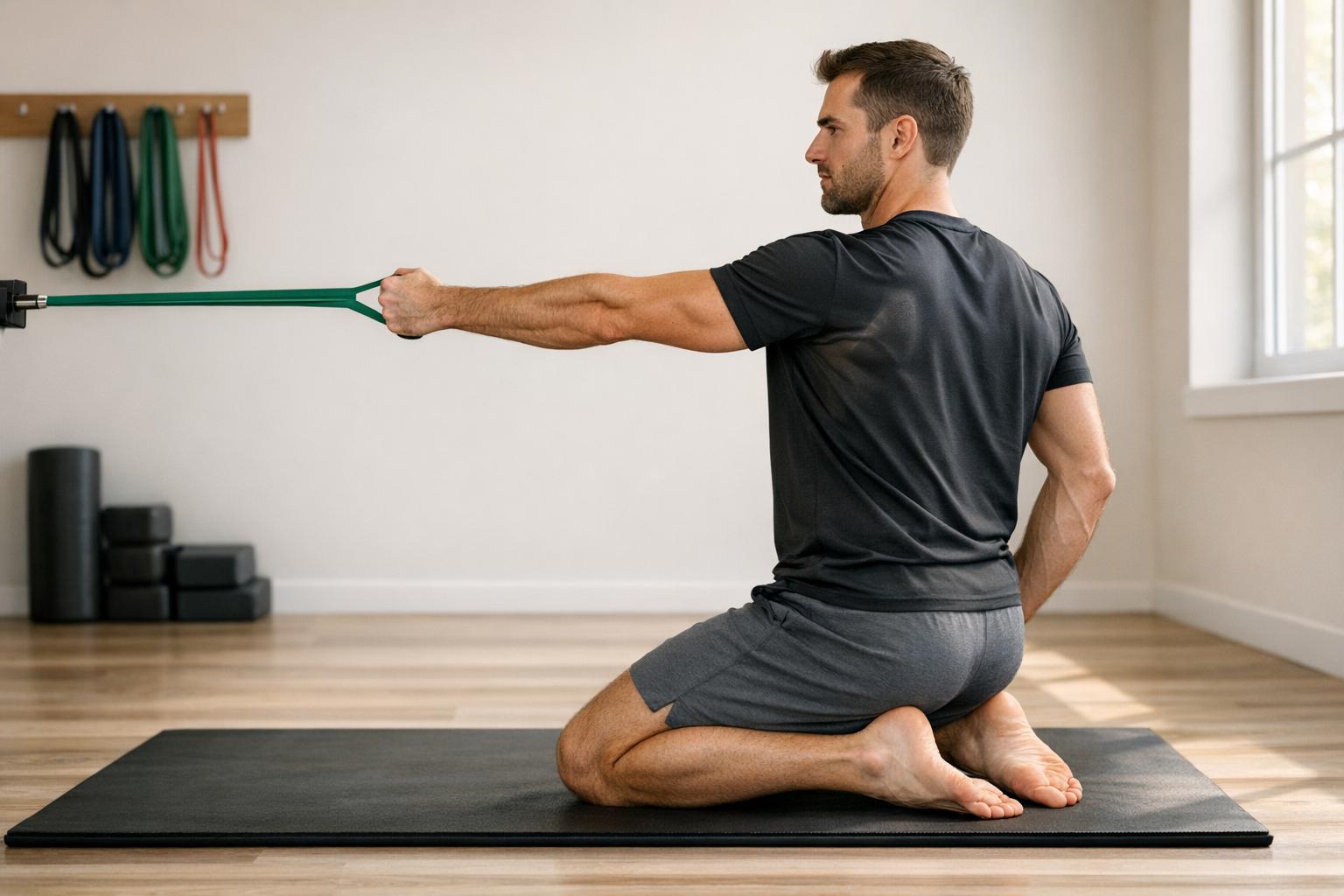
Elastic resistance exercises in kneeling positions can improve shoulder rehabilitation by engaging the entire kinetic chain – your legs, trunk, and arms working together. This approach strengthens weak shoulder muscles while reducing strain on sensitive areas like the rotator cuff. Here’s why it works:
- Kinetic Chain Activation: Movements start in the lower body and flow through the trunk to the shoulder, creating a stable foundation.
- Elastic Resistance Benefits: Bands delay peak resistance, making exercises easier at the start and harder as muscles strengthen.
- Kneeling Positions: These limit unnecessary lower-body movement, forcing the core and trunk to stabilize the shoulder more effectively.
A 2025 study with 19 participants showed elastic resistance improves scapular movement patterns (posterior tilt and internal rotation), reduces compensations, and supports recovery after injuries. This method is ideal for building shoulder stability and strength while protecting injured tissues.
Study Design and Methods
Participants and Testing Setup
The study involved healthy adult males who had no history of shoulder or neck issues. This was confirmed through a thorough range-of-motion screening and standard orthopedic evaluations[2][3].
For the testing setup, researchers used the Polhemus FASTRACK electromagnetic tracking device, known for its precision, with a positional accuracy of 0.3–0.8 mm and orientation accuracy of 0.15°[2]. This high level of accuracy was critical for capturing the subtle movements of the scapula, trunk, and humerus during the exercises. Before testing began, researchers determined each participant’s glenohumeral joint center using a least-squares algorithm based on passive arm movements[2]. These meticulous preparations ensured that the exercise protocols were grounded in reliable data.
Resistance Levels and Exercise Protocols
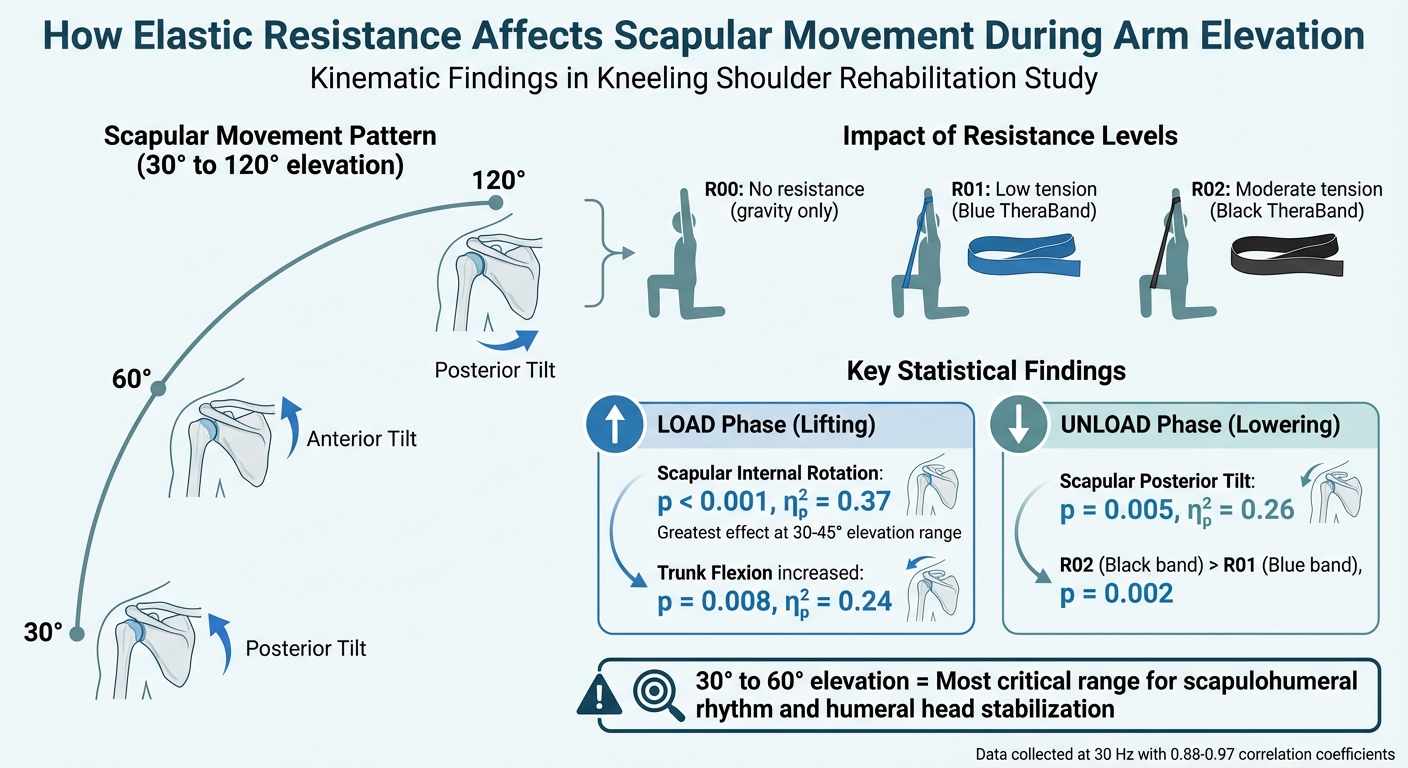
Participants completed the overhead squat exercise under three different resistance conditions. The first condition (R00) involved no external resistance, relying solely on gravity. The second condition (R01) used a low-tension Blue TheraBand, while the third condition (R02) incorporated a moderate-tension Black TheraBand[2]. To ensure consistency, the length of the resistance bands was adjusted to match each participant’s upper extremity length[3].
The exercises adhered to standardized postural guidelines. Participants aligned their feet with the ASIS (anterior superior iliac spine) and initiated movement from the lower body before engaging the shoulders[2]. Each exercise was divided into two phases: the LOAD phase, where participants raised their arms against resistance, and the UNLOAD phase, where they returned their arms to the starting position[2][4]. A metronome set at 60 beats per minute ensured a consistent pace, controlling the speed for both the concentric (lifting) and eccentric (lowering) movements[3]. This structured protocol allowed for precise and consistent kinematic measurements.
Kinematic Measurements
Collecting accurate kinematic data was a cornerstone of this study, as it plays an essential role in developing effective rehabilitation strategies. The electromagnetic tracking system recorded data at a frequency of 30 Hz, capturing detailed movement patterns[2]. Scapular rotations were analyzed using a Y-X′-Z″ Euler angle sequence to measure internal/external rotation, upward/downward rotation, and anterior/posterior tilt[3]. Additionally, trunk movements were assessed for flexion/extension, lateral flexion, and rotation, using a global reference coordinate system[2].
To map scapular behavior, measurements were taken at 15° intervals, covering the range from 30° to 120°[2]. To minimize noise in the data, a 6 Hz low-pass Butterworth filter was applied[3]. This rigorous approach resulted in highly reliable measurements, with trial-to-trial correlation coefficients ranging from 0.88 to 0.97[3].
The kinetic chain in shoulder rehab
Study Results and Kinematic Findings
Elastic Resistance Effects on Scapular Kinematics During Shoulder Rehabilitation
Scapular and Trunk Movement Patterns
When the arm was elevated from 30° to 120°, the scapula exhibited distinct movement patterns. At 30°, it showed a noticeable posterior tilt, shifted to an anterior tilt at 60°, and then returned to a posterior tilt by 120°[2]. Additionally, during the loading phase with elastic resistance, trunk flexion increased, underscoring the role of core stabilization in supporting these movements[2].
How Resistance Levels Affect Movement
The impact of resistance on movement patterns became evident through the study. Elastic resistance significantly influenced scapular positioning, particularly in the early to mid-range of arm elevation (30° to 60°). During the LOAD phase, elastic resistance caused an increase in scapular internal rotation (p < 0.001, η2ₚ = 0.37)[2]. Specifically, between 30° and 45°, the scapula showed greater internal rotation compared to movements without resistance[2].
"Increasing resistance through elastic resistance significantly improves scapular kinematics via the trunk during arm elevation."
– Fagner Luiz Pacheco Salles, Researcher, University of Lisbon [2]
In the UNLOAD phase, resistance led to an increase in scapular posterior tilt (p = 0.005, η2ₚ = 0.26). The moderate-tension condition (R02) resulted in a greater posterior tilt compared to the low-tension condition (R01) (p = 0.002)[2]. Trunk flexion and extension were also influenced during the LOAD phase (p = 0.008, η2ₚ = 0.24)[2], further highlighting the interconnected nature of trunk and scapular movements under resistance.
Glenohumeral and Scapulohumeral Movement Ratios
The study shed light on the interplay between joints, particularly the scapulohumeral rhythm, which was most affected by resistance within the 30° to 60° range of arm elevation. This range proved critical for stabilizing the humeral head, emphasizing the importance of dynamic neuromuscular strategies to maintain control as the arm elevates further[2]. Interestingly, resistance levels led to varied scapular responses, which required adaptive neuromuscular strategies to ensure stability in coordination with the thoracic spine[2]. These findings provide valuable insights for creating rehabilitation programs that enhance shoulder stability under different resistance conditions.
sbb-itb-ed556b0
Clinical Applications for Rehabilitation
Building Scapular Stability and Trunk Engagement
Rehabilitation strategies often focus on creating a strong connection between the trunk and shoulder. Elastic resistance exercises performed in kneeling positions are particularly effective because they promote a proximal-to-distal energy transfer – from the lower body, through the trunk, and into the scapula[2]. This method helps prevent overuse of the rotator cuff by distributing the workload more evenly.
Incorporating the kinetic chain into shoulder rehabilitation increases activation of axioscapular muscles, especially the lower trapezius and serratus anterior, while reducing excessive strain on the rotator cuff[1]. For example, a kneeling push-up plus combined with lifting the opposite leg (heterolateral leg extension) achieves an ideal Upper Trapezius to Lower Trapezius activation ratio of about 1.03. This balance is crucial, as it avoids the upper trapezius dominance often seen in shoulder dysfunction[1]. Interestingly, in overhead activities like serving in tennis, the legs and trunk generate 50% to 55% of the total kinetic energy required[1]. This highlights the importance of trunk engagement, even when the focus is on shoulder rehabilitation. These integrated muscle activations explain why kneeling exercises are so effective for optimizing shoulder function.
Why Kneeling Positions Work Better
Kneeling exercises provide a controlled setup that limits compensatory movements from the lower body while challenging core stability. Unlike standing, kneeling positions reduce the degrees of freedom, forcing the trunk and the lumbopelvic-hip complex to stabilize the scapula more effectively[1][2].
For example, a kneeling push-up plus with same-side (homolateral) leg extension produces a favorable 0.4 Upper Trapezius to Serratus Anterior ratio, indicating excellent serratus anterior activation[1]. Elastic resistance bands play a key role here, as they offer a progressive load that matches the joint’s strength curve. Unlike traditional free weights, which rely solely on vertical gravity, elastic resistance allows clinicians to challenge the shoulder in multiple planes, such as anterior-posterior and medio-lateral[6].
Using These Techniques at Portland Chiropractic Group
Portland Chiropractic Group has embraced these biomechanical insights to create a structured progression model for rehabilitation. Guided by kinematic data, their approach starts with strength endurance exercises (high volume, low intensity), progresses to maximal strength training, and concludes with explosive strength exercises that focus on improving the rate of force development[6]. Strain gauge technology is used to monitor force levels, which is especially critical after rotator cuff repairs, where peak loads typically range from 21 to 54 N[5][6].
Functional training includes exercises like kneeling external rotation combined with trunk rotation, which maximizes lower trapezius activation through lateral weight transfer[1]. To maintain accuracy, the team regularly recalibrates the force-displacement profile of elastic bands, as these bands lose elasticity over time[6]. This level of precision ensures that patients achieve measurable and consistent rehabilitation outcomes.
Conclusion
Elastic resistance exercises performed in kneeling positions engage the entire kinetic chain, making them a powerful tool for effective shoulder rehabilitation [2].
Kinematic data reveals a significant improvement in scapular posterior tilt during the UNLOAD phase (p = 0.005, η²ₚ = 0.26). This underscores the importance of maintaining proper scapular alignment to help reduce impingement issues [2]. The trunk plays a critical role as a stable base, allowing for efficient force generation and controlled movements throughout the shoulder complex. This controlled modulation of resistance is key to achieving the mechanical benefits observed.
Elastic resistance bands also improve scapular kinematics during arm elevation by leveraging the trunk’s stability, as highlighted in the study [2]. These bands adapt to the muscle’s strength curve, increasing resistance as the muscle reaches peak strength, which provides a clear advantage over constant-load devices [6].
Portland Chiropractic Group has embraced these findings, implementing structured progressions that range from strength endurance to explosive strength training. By using strain gauge technology, they deliver precise and measurable rehabilitation outcomes. Regular calibration of equipment and careful monitoring of forces ensure that patients regain improved shoulder function in practical, everyday scenarios.
FAQs
How do kneeling exercises with elastic resistance improve shoulder rehabilitation?
Kneeling exercises are great for building a solid foundation by activating the core, hips, and lower body. This setup supports proper shoulder mechanics by reducing unnecessary movements, encouraging better posture, and improving how the shoulder blade (scapula) is positioned – key factors for effective shoulder recovery.
Adding elastic resistance to these exercises takes things up a notch. It introduces a controlled, progressive challenge that engages the stabilizing muscles around the shoulder. Plus, it promotes smooth, coordinated movements throughout the body. Together, this combination boosts strength, mobility, and coordination, making it an excellent approach for shoulder rehab and enhancing overall physical function.
What are the benefits of using elastic resistance bands for improving scapular movement during shoulder rehabilitation?
Elastic resistance bands are a great way to target the muscles responsible for stabilizing and moving the scapula. They offer variable resistance throughout each movement, which helps engage important stabilizing muscles like the serratus anterior and lower trapezius. This can lead to better control of the scapula, promoting smoother upward rotation and posterior tilt during arm movements.
Another benefit of using bands is the improvement in proprioception and motor control, both of which are essential for creating a strong and functional shoulder kinetic chain. Research suggests that regular use of elastic bands can boost muscle strength and even lead to early hypertrophy in scapular stabilizers within just a few weeks. These advantages make elastic resistance bands an effective and research-backed option for enhancing scapular movement and overall shoulder performance.
Why is core stability important for shoulder rehabilitation exercises?
Core stability plays a key role in creating a solid base for transferring force efficiently through the kinetic chain – from your lower body, through your trunk, and up to your shoulder. When your core is stable, it limits unnecessary trunk movement, which allows your shoulder muscles to function more effectively and stay in sync. This stability boosts the activation of critical muscles like the rotator cuff and scapular stabilizers, while also cutting down on compensatory movements that could lead to strain or injury.
In shoulder rehabilitation, a stable core helps maintain proper alignment and mechanics. It enables the hips and trunk to support scapular positioning and shoulder movement, creating a dependable foundation for recovery. This not only improves muscle engagement but also ensures that force is transferred efficiently, avoiding inefficient patterns that could slow down healing or impact performance.
Related Blog Posts
- Evidence Based Kettle Bell Exercises for Shoulder Pain
- Stuart McGill Kettlebell Exercises for Shoulder Rehabilitation Explained
- Effectiveness of Articular and Neural Mobilization for Managing Cervical Radicular Pain: A Systematic Review With Network Meta-Analysis
- Effectiveness of fascial manipulation® versus eccentric training with static stretching on patellar tendinopathy – A randomized clinical trial

Comments are closed