

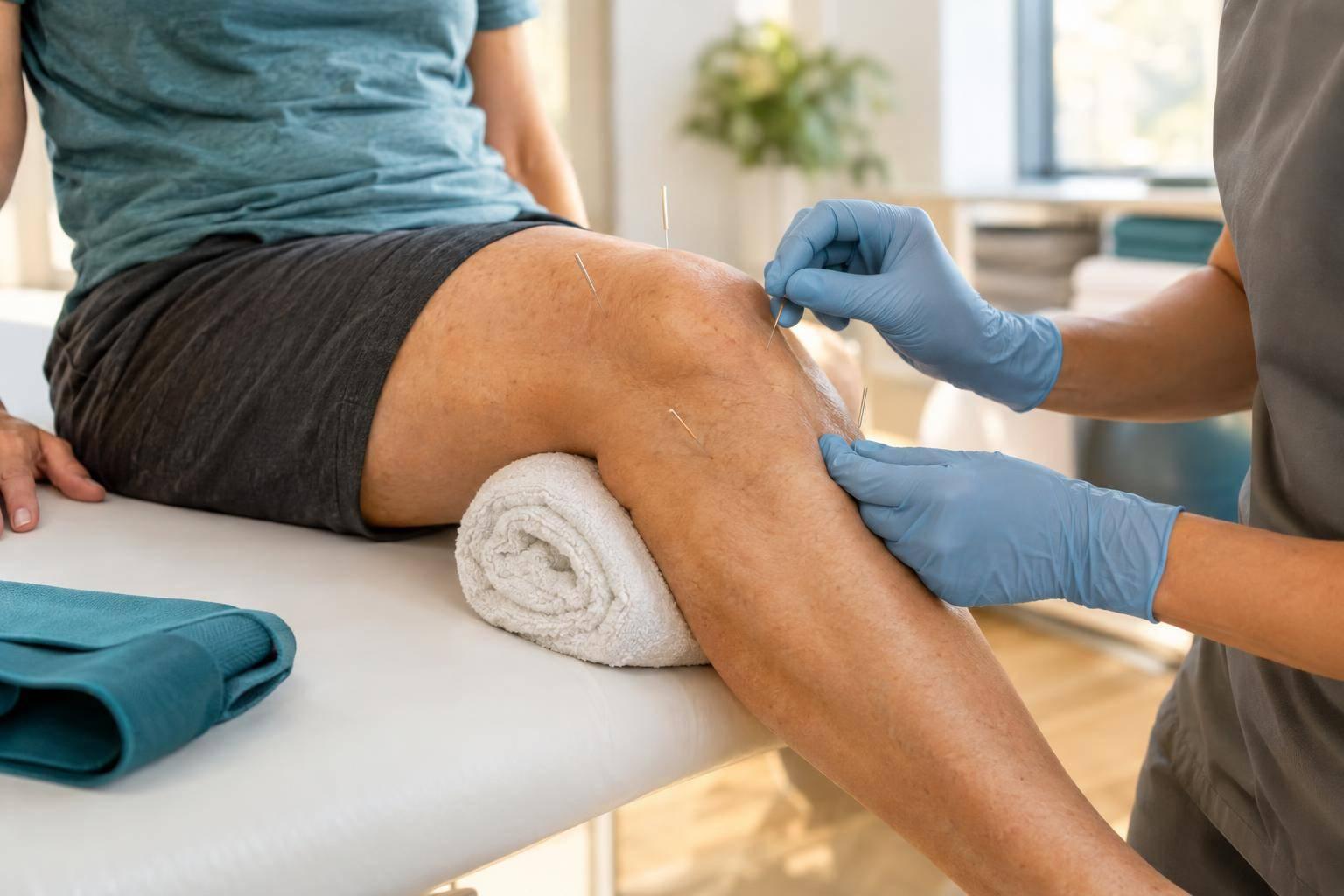
Dry needling plus stretching led to better average knee pain, function, and movement outcomes than oral diclofenac plus stretching in a 98-person trial. The advantage remained at 6 months, but only 77 participants completed the study. Treatment choices should account for medical risks, clinic visits, cost, and patient preferences – not these results alone.
Both groups received 6 weeks of treatment. Needling targeted active and latent muscle trigger points around the knee, not joint damage. The study did not report enough safety data to compare harms, and its blinding and missing follow-up data limit certainty.
Quick Comparison
| Factor | Dry needling plus stretching | Oral diclofenac plus stretching |
|---|---|---|
| Treatment | Needles placed in muscle trigger points | Oral anti-inflammatory medicine |
| Trial results | Greater average symptom and function improvements | Improvements, but less than with needling |
| Practical demands | Clinic visits and tolerance for needles | Taking medicine on a schedule |
| General risks – not trial findings | Soreness, bruising, bleeding, and infection | Stomach bleeding, kidney injury, and heart attack or stroke |
Neither treatment repairs cartilage or cures osteoarthritis. A clinician can help weigh these options alongside exercise and other care. Diclofenac should not be changed without the prescribing clinician’s guidance.
Dry Needling To Treat Knee Osteoarthritis (OA)
sbb-itb-ed556b0
Comparing Dry Needling and Diclofenac With Stretching
This single-blind randomized trial enrolled 98 participants to compare two 6-week treatment plans: dry needling plus stretching and oral diclofenac plus stretching. Both groups stretched, so the study compared the combined treatments – not dry needling or diclofenac alone.[7]
| Comparison | Dry needling group | Diclofenac group |
|---|---|---|
| Treatment components | Muscle trigger-point needling plus stretching | Oral diclofenac plus stretching |
| Treatment duration | 6 weeks | 6 weeks |
| Follow-up | 6 months after treatment began | 6 months after treatment began |
| Main outcomes assessed | Pain (Numeric Pain Rating Scale, NPRS); knee-related function (Western Ontario and McMaster Universities Osteoarthritis Index, WOMAC); knee range of motion (ROM) | Same measures |
The report does not describe adverse effects clearly enough to compare the treatments’ safety.
Dry Needling: Procedure and Precautions
The protocol combined trigger-point needling with stretching. It targeted muscles that may contribute to knee osteoarthritis pain – not the knee joint itself.
Choose a properly trained clinician who explains the procedure, gets informed consent, and uses sterile technique. Before treatment, tell them about blood thinners, bleeding problems, impaired sensation, skin infection, pregnancy, or anxiety about needles.
Temporary soreness, bruising, bleeding, fainting, and infection are general risks of the procedure. They were not confirmed events in this trial. The comparison group received diclofenac plus stretching.
Oral Diclofenac: Uses and Risks
Diclofenac is a nonsteroidal anti-inflammatory drug (NSAID) that reduces pain and inflammation. Its major risks include stomach bleeding, kidney injury, and heart attack or stroke.
Whether it’s suitable for you depends on your age, ulcer history, kidney or heart disease, high blood pressure, dehydration, and other medicines. Ask a clinician or pharmacist to review your medicines and supplements. Don’t change your diclofenac use without a clinician’s advice.
Use after 20 weeks of pregnancy can affect fetal kidney function and amniotic fluid. Avoid use after 30 weeks unless a clinician directs it.[4][5][6]
The next section explains how the trial measured pain, function, and range of motion.
How the Trial Was Conducted
Knee Osteoarthritis Trial: WOMAC Scores Over 6 Months
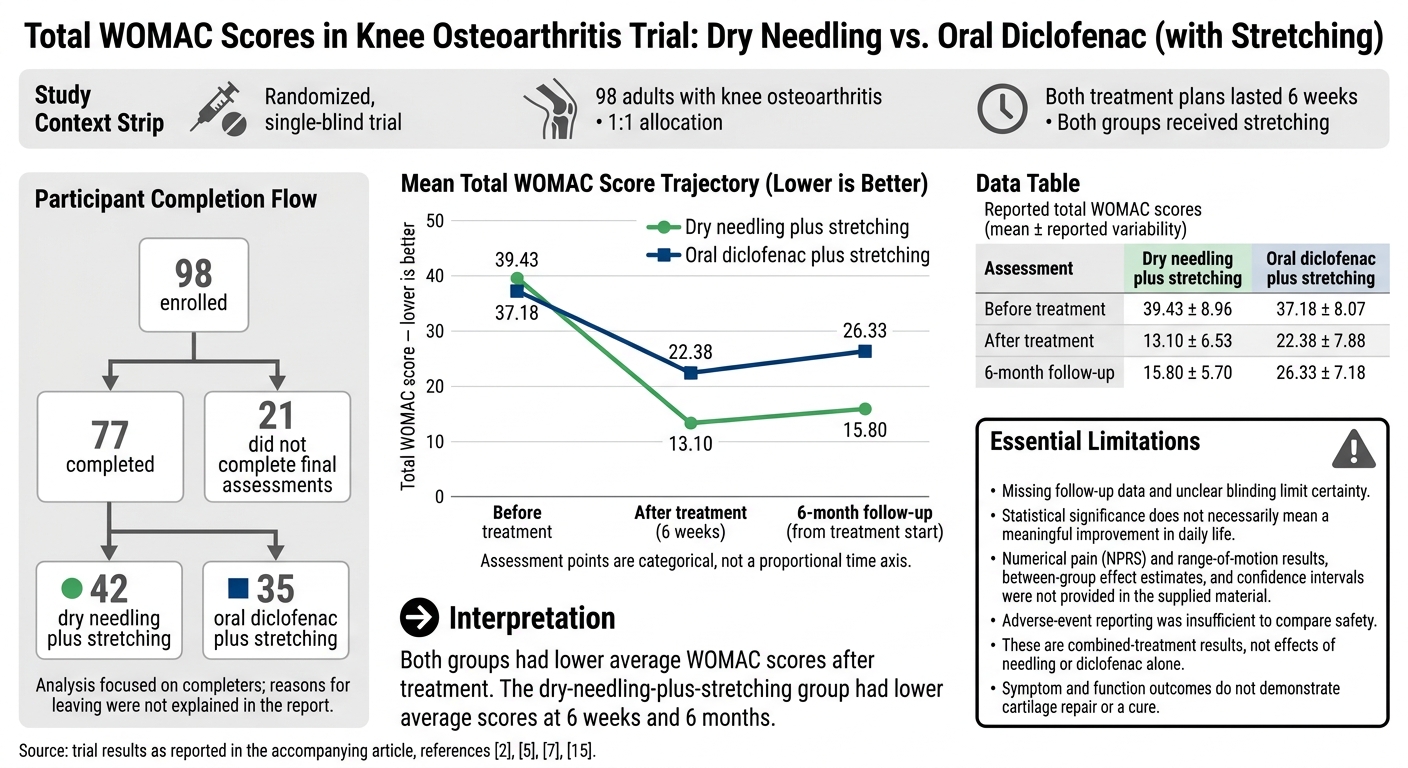
This randomized, single-blind trial enrolled 98 adults with knee osteoarthritis. Researchers used computer-generated random numbers to assign them to two groups in a 1:1 ratio.[1][2] The report does not clearly state who was blinded. Full blinding would have been difficult because the treatments looked different. Researchers measured pain, function, and knee movement at scheduled follow-ups.
Seventy-seven participants completed the study: 42 in the dry-needling group and 35 in the diclofenac group. The analysis focused on these completers. Missing final assessments from 21 participants reduce certainty in the findings, and the report did not explain why they left.[1][2][10]
Measuring Pain, Knee Function, and Range of Motion
Researchers assessed participants before treatment, after the 6-week treatment period, and at 6 months. They used the Numeric Pain Rating Scale (NPRS) to measure pain intensity and the Western Ontario and McMaster Universities Osteoarthritis Index (WOMAC) to assess knee symptoms and difficulty with physical activities. Range of motion (ROM) measured knee movement.[8][9]
The supplied material does not confirm which device or procedure researchers used to measure ROM. Also, statistical significance does not always translate into a meaningful change in daily life.
Results After Treatment and at 6 Months
Both groups improved, but the dry-needling group showed greater improvement.[1][2] The table shows total WOMAC scores.[3] The supplied material does not include numerical NPRS or ROM results, between-group effect estimates, or confidence intervals.
| Assessment | Dry needling: total WOMAC | Diclofenac: total WOMAC |
|---|---|---|
| Before treatment | 39.43 ± 8.96 | 37.18 ± 8.07 |
| After treatment | 13.10 ± 6.53 | 22.38 ± 7.88 |
| 6-month follow-up | 15.80 ± 5.70 | 26.33 ± 7.18 |
The authors reported that the dry-needling group maintained its advantages through at least 6 months.[1] These results concern symptom relief and function – not cartilage repair or a cure.
The next section weighs these findings against the study’s limitations.
Treatment Trade-Offs and Evidence Limits
This trial compared dry needling plus stretching with oral diclofenac plus stretching. It did not report adverse-event rates.[2][11] Choosing between these options means weighing symptom relief, treatment demands, and medical risks. The table separates the trial’s results from practical considerations.
| Consideration | Dry needling plus stretching | Oral diclofenac plus stretching |
|---|---|---|
| Symptom relief: trial findings | Greater average improvements in pain, function, and knee range of motion at treatment completion and at 6 months.[2][11] | Improved the same measures, but less than the dry-needling group.[2][11] |
| Duration: trial findings | Better average outcomes at 6 months do not guarantee lasting relief for every patient.[2][11] | Improvements were also reported at follow-up, but the dry-needling group did better on average.[2][11] |
| Practical burden | Requires clinic visits and tolerance for needles. | Requires taking oral medicine on a schedule. |
| Clinician assessment | A clinician should confirm the pain source, identify appropriate trigger points, and check for bleeding or infection risk. | A clinician should review medical history and all medicines before deciding whether an oral NSAID is appropriate. |
What This Trial Cannot Tell Us
Single blinding may have influenced expectations and how participants reported pain. Only 77 participants completed the study, so missing data could have biased the 6-month result.[2][11]
The trial also compared two treatment packages, not either treatment alone. It therefore cannot tell us the effect of either treatment by itself.[2][11] These limits affect how much weight the results deserve.
What Other Research Says
A systematic review and meta-analysis reported moderate-quality evidence that periosteal stimulation improved pain and function in the short term.[15] But periosteal stimulation is a different needling method. It should not be grouped with trigger-point dry needling.
A review of periosteal electrical dry needling included six studies. Four reported statistically significant improvements in pain and mobility, but the authors called for larger trials.[12][14] Another review found short-term improvements but rated the overall evidence very low because of bias, differences among studies, and imprecision.[13]
The broader evidence is mixed, leaving symptoms, medical risks, and tolerance for needles or NSAIDs as factors in treatment decisions.
Conclusion: Choosing Treatment With Your Clinician
Both treatments improved pain, function, and knee motion. Dry needling produced better results and stayed ahead at 6 months.[1][11]
The choice still depends on your risks, goals, and preferences – not just which treatment performed better. When comparing a procedure-based option with an oral NSAID, talk with your clinician about your symptoms, activity goals, health history, and comfort with needles or medication.
Discuss cost and follow-up, too: how many visits you’ll need, the total cost, how progress will be checked, and where stretching and strengthening fit into your plan. Do not change diclofenac without your prescribing clinician’s guidance.
FAQs
How do active and latent trigger points differ?
Both are tight, knotted spots in muscles that can limit movement. Active trigger points hurt on their own and often reproduce the pain a person feels during daily activities. Latent trigger points usually hurt only when pressed, but they can still cause muscle tightness and restrict range of motion. Dry needling targets both types to help release tight muscle fibers and improve muscle function.
How can I tell if trigger points contribute to my knee pain?
Trigger points are tight knots in muscles that can form as those muscles compensate for joints affected by knee osteoarthritis. Tenderness in a specific spot or tension that limits your usual range of motion may suggest these knots are contributing to your pain.
During an evaluation, a provider may press on these spots to see if they bring on your familiar pain or cause a brief, involuntary muscle twitch – a hallmark of a reactive trigger point.
Were the trial’s improvements large enough to matter day to day?
Yes, the trial’s improvements were large enough to make daily life easier. Research indicates that dry needling helps restore normal muscle function and reduce joint stress, making movement more comfortable. Patients report less pain and better mobility, which makes everyday tasks like getting up from a chair or climbing stairs easier.
Related Blog Posts
- What Conditions are Dry Needling Beneficial For?
- What is the Difference Between Neurological Dry Needling, Trigger Point Dry Needling, and Electrical Muscle Stimulation Dry Needling?
- How Does Dry Needling Help with Arthritis in Oklahoma City?
- Neurophysiological Effects of Dry Needling: A Systematic Review and Meta-analysis

Comments are closed