

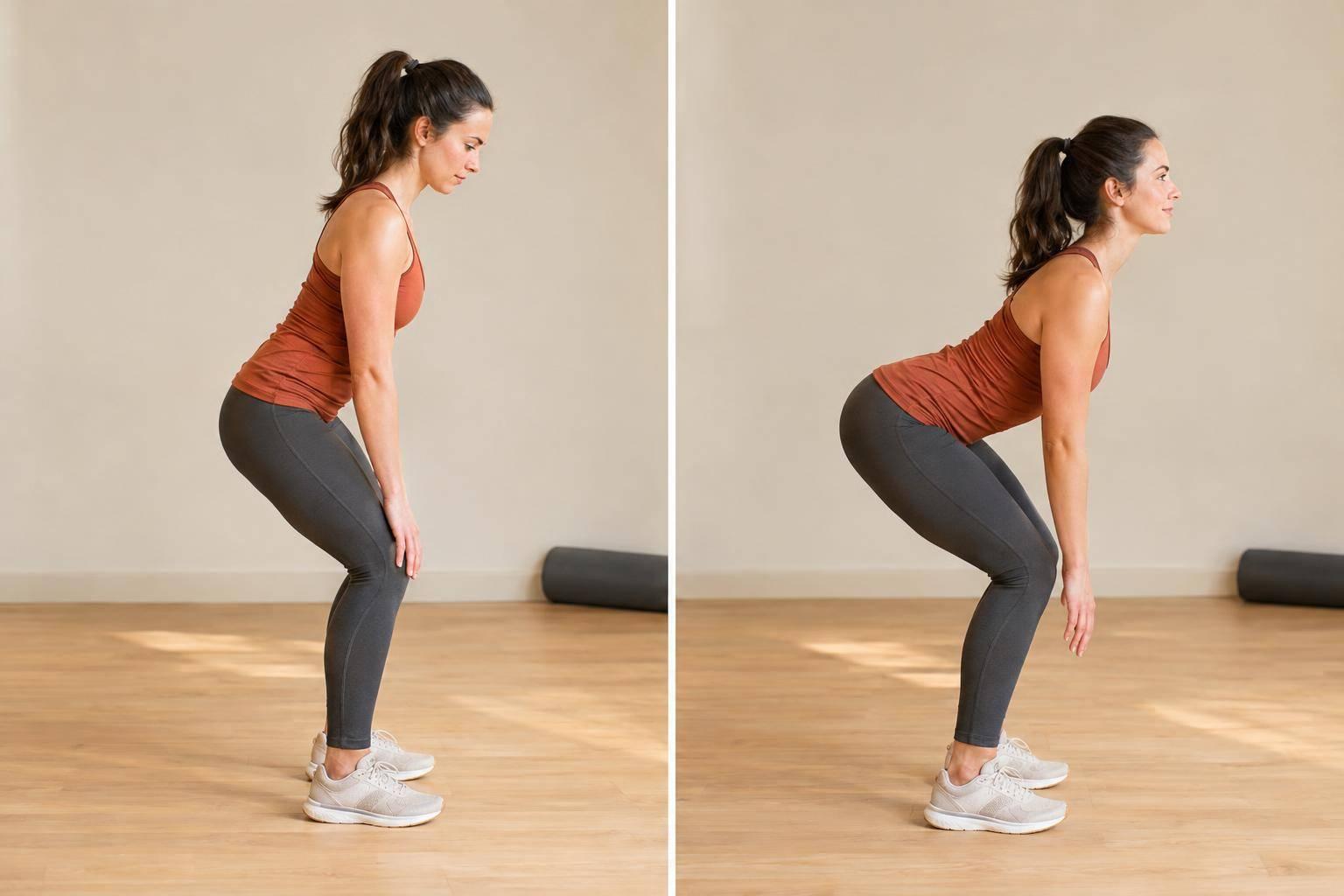
One brief Founder exercise lesson was followed by changes in hip-hinge movement and greater confidence in 33 healthy adults – but not proof of safer lifting or pain relief. After about 8 minutes of coaching, average hip flexion increased from 80.7° to 104.6°, and the median summed confidence score rose from 40 to 49.
Shoulder and head-trunk angles also changed. But different angles and higher confidence do not necessarily mean better movement. With no separate control group and only immediate retesting, the study could not separate instruction from practice or show lasting effects. It did not test injury risk, pain, or recovery, so these results alone should not guide injury treatment.
Study Design: Before-and-After Testing in 33 Healthy Adults
Researchers tested 33 healthy adults before and after instruction, with each person serving as their own comparison. Participants averaged 25.1 years old, and 72.7% were female. There was no separate control group.[1][2]
How Movement and Confidence Were Measured
Researchers assessed hip-hinge mechanics through video analysis and measured self-reported movement confidence with brief survey items. They marked anatomical landmarks, then used an iPad app to measure hip, knee, ankle, shoulder, and head-trunk angles in side-view video. They measured foot orientation with a goniometer.[3] These measurements covered selected 2D angles, not full 3D spinal or pelvic motion.[2]
Participants also answered 5-point confidence items about tasks such as lifting, bending, and squatting. Higher scores meant greater reported confidence. Researchers also examined a summed confidence score for exploratory analysis.[3]
Study Design at a Glance
Testing measured immediate responses to a movement lesson – not long-term change.[1][5]
| Study component | Pretest | Posttest |
|---|---|---|
| Instruction | No Founder instruction had been delivered | One standardized Founder instructional session completed |
| Movement assessments | Foot orientation and side-view hip, knee, ankle, shoulder, and head-trunk angles recorded | The same assessments repeated |
| Confidence assessments | Self-reported movement-confidence items and a summed score for exploratory analysis | The same items and score repeated |
| Measured outcomes | Baseline movement angles and perceived confidence | Within-person differences |
| Clinical outcomes | Pain, disability, injury recovery, and long-term function not assessed | These outcomes remained unmeasured |
Everyone received instruction and was retested immediately afterward. That means the study could not separate the effects of instruction from practice, cueing, attention, or repeat testing. It also did not test whether participants retained what they learned or how they performed under load.[1][2]
The next section covers the pre-to-post changes in movement angles and confidence.
sbb-itb-ed556b0
Results: Immediate Changes After Instruction
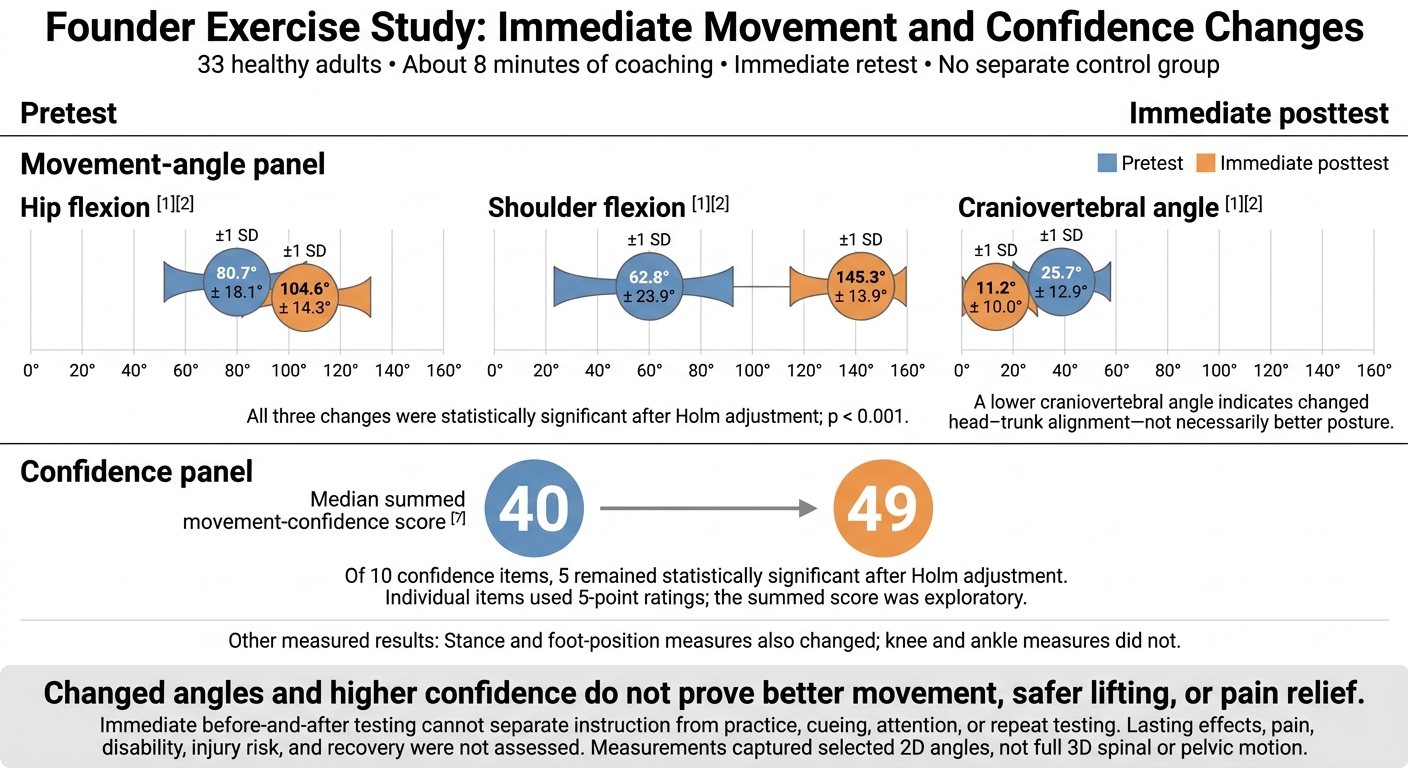
Founder Exercise Study: Immediate Movement and Confidence Changes
Changes in Hip, Shoulder, and Head-Trunk Angles
| Movement variable | Pretest, mean ± SD | Posttest, mean ± SD | Adjusted result |
|---|---|---|---|
| Hip flexion | 80.7° ± 18.1° | 104.6° ± 14.3° | Statistically significant after Holm adjustment; p < 0.001.[1][2] |
| Shoulder flexion | 62.8° ± 23.9° | 145.3° ± 13.9° | Statistically significant after Holm adjustment; p < 0.001.[1][2] |
| Craniovertebral angle | 25.7° ± 12.9° | 11.2° ± 10.0° | Statistically significant after Holm adjustment; p < 0.001.[1][2] |
Stance and foot-position measures also changed, but knee and ankle measures did not.[1][6]
A lower craniovertebral angle shows a change in head-trunk alignment. It does not, by itself, mean better posture.
Reported confidence also changed alongside the measured movement angles.
Changes in Reported Movement Confidence
The median summed confidence score increased from 40 to 49. Of the 10 items, 5 remained statistically significant after Holm adjustment.[5]
Higher confidence does not prove better performance or protection from injury.
The next section explains what these short-term changes do – and do not – mean.
What the Findings Mean
After one Founder session, selected two-dimensional angles and confidence scores changed immediately. But the study cannot show whether instruction caused those changes.[1] The findings describe a short-term response to coaching, not proof of lasting change.
Study Limits and Outcomes Not Measured
Testing took place immediately after instruction. That means the results do not show whether the changes lasted beyond the session or carried over to functional tasks.[1]
Two-dimensional analysis measures selected visible angles – not the spine and pelvis’s full three-dimensional movement. The study did not establish changes in low-back and pelvic control, muscle activation, spinal loading, or movement efficiency. It also did not assess pain, disability, or injury risk. A larger hip angle does not prove better low-back and pelvic control or a safer lift.[1]
The findings concern movement instruction in healthy adults, not treatment effects. They should not guide treatment for back, hip, or other injuries on their own. People with injuries may tolerate different ranges of motion or need different cues than healthy participants.[1]
Research Needed Before Treatment Claims
The findings remain preliminary. Larger randomized trials should measure lumbar and pelvic motion, muscle activity, and lifting forces. Follow-up testing would help show whether participants retain the movement without coaching and use it during lifting or daily activities. Clinical studies would also need validated measures of pain, disability, function, and adverse events.[1]
Conclusion: Findings and Practical Limits
The findings suggest an immediate coaching effect, not a proven treatment effect. Among 33 healthy adults, one Founder session was followed by changes in selected hip, shoulder, and head-trunk angles, along with higher self-reported confidence. Neither finding proves lasting functional change.[1][2]
What the Study Supports – and Does Not Establish
| Supported by this study | Not established by this study |
|---|---|
| Healthy adults changed how they performed the tested hip-hinge task after instruction.[1] | Clinical effectiveness for people with back pain, injuries, or other medical conditions; reduced injury risk; or lasting clinical change |
Brief movement instruction may serve as a teaching tool, but the study does not show whether those changes last.
FAQs
How does the Founder exercise teach a hip hinge?
The provided materials don’t explain the Founder exercise or how it teaches a hip hinge. They cover other stability, mobility, and functional movement exercises, but don’t describe the Founder’s mechanics or teaching methods.
How can I tell if my hip hinge is controlled?
A controlled hip hinge should feel smooth and steady, with little effort. Keep your spine neutral – don’t arch, twist, or let it sag. Keep your hips and knees aligned, and use your core to steady the movement.
Stop and seek a clinician’s evaluation if you have sharp or worsening pain, lose function, or still can’t perform the movement safely after reducing the intensity.
How can I check whether movement changes last?
Look for smoother, more natural movement that takes less effort during daily activities [1]. Track your pain levels, activities that trigger symptoms, and coordination. Compare these notes with your starting point every 4 to 6 weeks, since short-term gains can fade [2][1][3].
At Portland Chiropractic Group, your clinician will regularly check whether your movement patterns remain stable or your program needs changes to help maintain results [1][4].

Comments are closed