

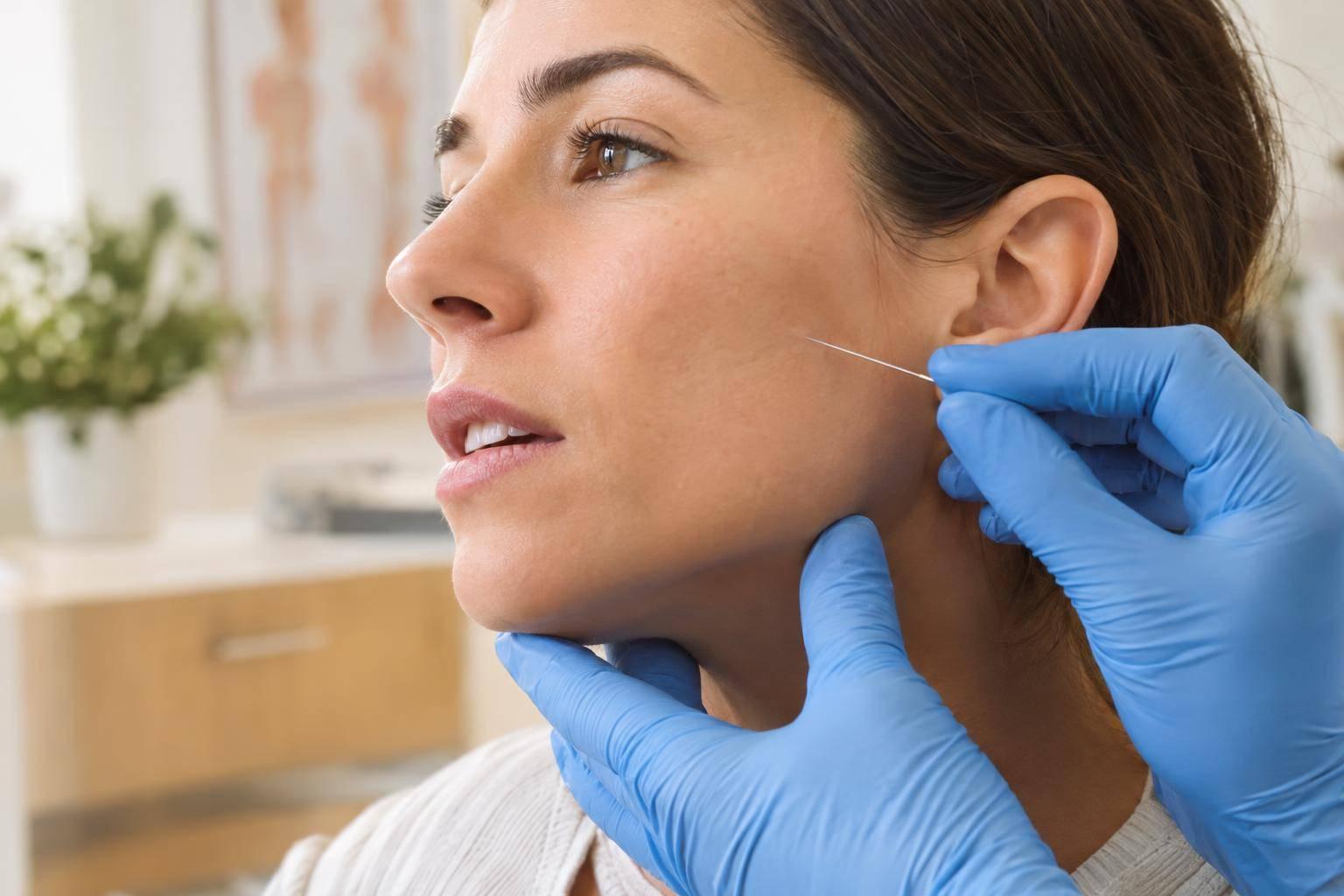
Dry needling of the lateral pterygoid may ease jaw-muscle pain, but lasting relief and safety remain uncertain. Before treatment, a qualified clinician should confirm the pain source and review bleeding risks, medications, and other care options.
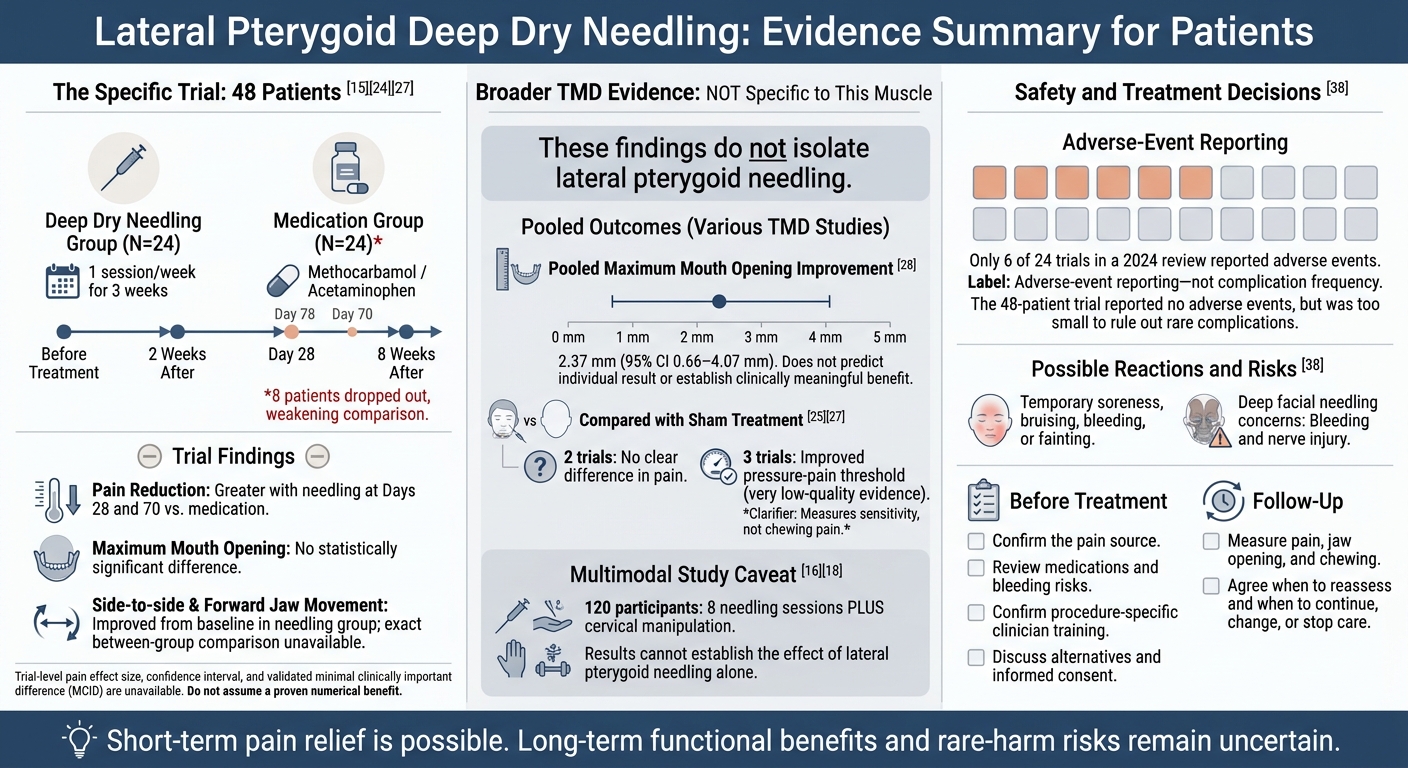
A 48-patient trial found greater pain relief with needling than with medication, but no clear advantage in maximum mouth opening. Eight medication-group patients dropped out, which weakens the comparison.
The main points:
- Results vary: Studies treating other jaw muscles or combining needling with other treatments cannot establish how well lateral pterygoid needling works alone.
- Safety data are limited: Only 6 of 24 trials in a 2024 review reported adverse events. Deep facial needling carries bleeding and nerve-injury risks.
- Treatment needs a clear plan: Procedure-specific training, informed consent, and follow-up measures for pain, jaw movement, and chewing should guide care.
Lateral Pterygoid Dry Needling: Benefits and Evidence Limits
2. Study Methods and Treatment Comparisons
The 48-Patient Lateral Pterygoid Trial
This randomized clinical trial enrolled 48 patients with chronic myofascial pain linked to the lateral pterygoid muscle. Half received deep dry needling (DDN); the other half received methocarbamol/acetaminophen. The needling group had one session per week for 3 weeks. The medication group took two tablets every 6 hours for 3 weeks.[7]
The control group received medication – not sham needling. That difference matters when comparing these results with studies that used simulated needling or other treatments.
Researchers measured pain at rest and during chewing, maximum mouth opening, side-to-side jaw movement (lateral excursion), and forward jaw movement (protrusion). They assessed patients before treatment and at 2 and 8 weeks after treatment.[7]
Comparison With Other TMD Studies
The table separates studies focused on one muscle from those testing treatments across several muscles or combining treatments.
| Study/source | Sample size | Muscle targets | Comparator | Outcomes | Follow-up | Key findings |
|---|---|---|---|---|---|---|
| Lateral pterygoid trial[7] | 48; 24 DDN, 24 medication | Lateral pterygoid | Methocarbamol/acetaminophen | Pain at rest and during chewing; maximum mouth opening; lateral excursion; protrusion | Before treatment, 2 weeks, and 8 weeks after treatment; about 11 weeks total | Both groups had less pain, but DDN reduced pain more; DDN also improved mouth opening, lateral excursion, and protrusion |
| Double-blind sham-controlled trial[5] | 36 | Bilateral masseter | Simulated needling | |||
| Dry needling versus manual therapy trial[3] | 27 in the lateral pterygoid subgroup; 14 DDN, 13 manual therapy | Myofascial TMD targets; lateral pterygoid subgroup reported separately | Manual therapy | Pain; active maximum mouth opening; cervical disability; pressure-pain threshold | Both approaches led to similar improvements | |
| Rehabilitation-adjunct pilot[4] | Masseter and temporalis | Standard rehabilitation plus a single dry-needling session | Pressure-evoked pain; quality of life | Early differences were reported, but the small pilot design limits conclusions | ||
| Dunning et al. multimodal trial[8][9] | 120; 62 intervention, 58 control | Lateral pterygoid, superficial masseter, temporalis, and posterior TMJ capsule | Interocclusal splint therapy, diclofenac, and TMJ mobilization | Jaw pain; active pain-free opening | 2 weeks, 6 weeks, and 3 months | Dry needling plus upper-cervical manipulation led to greater improvements at 3 months, but the separate effect of dry needling is unclear |
Blank cells indicate details not reported in the source summary.
Dunning and colleagues paired eight needling sessions with cervical manipulation, so their results cannot show the effect of lateral pterygoid needling alone.[8][9]
sbb-itb-ed556b0
3. Results: Pain Relief and Jaw Movement
Results of the Lateral Pterygoid Trial
In Gonzalez-Perez and colleagues’ trial, dry needling reduced pain more than medication at days 28 and 70. But eight patients in the medication group dropped out, weakening the comparison.[7][11][13] Pain relief matters, but jaw function also depends on movement.
Jaw movement improved from baseline in the needling group. However, a systematic-review summary found no significant difference between groups in maximum mouth opening.[7][11][13] The supplied trial summaries do not report exact millimeter changes, group means, variability estimates, or confidence intervals. Broader TMD studies show less consistent results.
Mixed Results in Other TMD Studies
A randomized study comparing dry needling with manual therapy found similar improvements in pain, active maximum mouth opening, cervical disability, and pressure-pain threshold.[10]
Across broader TMD trials comparing dry needling with sham treatment, two trials found no clear difference in pain. Three trials found an improvement in pressure-pain threshold, but the evidence was very low quality.[12][13] Pressure-pain threshold measures sensitivity – not chewing pain. These pooled findings come from broader TMD studies, not the lateral pterygoid trial.
Which Outcomes Does the Evidence Support?
| Outcome | Supporting evidence | Meaning | Uncertainty |
|---|---|---|---|
| Pain | The lateral pterygoid trial reported lower pain at days 28 and 70.[11][13] | May ease chewing pain. | The trial-level effect size, confidence interval, and validated minimal clinically important difference (MCID) are unavailable. |
| Maximum opening | The lateral pterygoid trial found no significant difference between groups; broader pooled evidence showed a 2.37 mm increase (95% confidence interval 0.66–4.07 mm).[11][13][14] | May make biting and oral care easier. | The pooled estimate does not predict an individual’s results or isolate the effect of lateral pterygoid needling. |
| Lateral excursion | Side-to-side movement improved from baseline.[7] | May improve chewing. | Exact millimeter changes and reliable between-group estimates are missing. |
| Protrusion | Forward jaw movement improved from baseline.[7] | May improve jaw mobility. | Precise effects and their importance for daily function remain unclear. |
Measured changes need to be considered alongside chewing, speaking, yawning, and oral hygiene. A statistical improvement alone does not establish a meaningful benefit, long-term relapse prevention, or better results than a full rehabilitation program.[2][12][13]
Treatment choice also depends on safety and screening – not just how well it works.
4. Safety, Patient Screening, and Clinician Training
Reported Safety and Possible Risks
Safety and patient selection matter alongside efficacy. Modest improvements in pain and movement do not remove the need for screening and clinician training.
The 48-patient trial reported no dry-needling adverse events, but it was too small to rule out rare complications. The summary also does not define adverse events, explain how they were monitored, or separate minor reactions from serious complications.
Possible reactions include temporary soreness, bruising, bleeding, or fainting. The lateral pterygoid lies deep near major facial structures, making bleeding and nerve injury the main concerns.[20] Seek urgent care for worsening swelling, uncontrolled bleeding, fever, increasing numbness or weakness, or severe or persistent pain. Problems with swallowing, speech, or breathing require emergency care.
Who Needs Screening or Extra Precautions?
Before treatment, clinicians should review medications and supplements, bleeding history, medical conditions, recent surgery, pregnancy when relevant, and past needle reactions or fainting. Screening should identify who needs to delay treatment and who can proceed with added precautions.
| Risk factor | Required action |
|---|---|
| Bleeding disorder or abnormal coagulation | Document bleeding history. Defer treatment or obtain medical input if prolonged bleeding or deep hematoma is a concern. |
| Anticoagulant or antiplatelet use | Record the drug, dose, indication, and prescriber. Assess bleeding risk and consult as needed. Do not stop prescribed medication independently.[16] |
| Active infection or open wound | Defer needling at the affected site and arrange medical or dental evaluation. |
| Impaired healing or immune suppression | Document the condition and medications. Consider medical input about infection risk and recovery. |
| Needle intolerance or prior fainting | Document past reactions and a monitoring plan. Defer for severe intolerance, inability to remain still, or refusal. |
| Pregnancy | Document pregnancy status and discuss the limited procedure-specific evidence. Seek obstetric or medical input when appropriate, especially for high-risk pregnancy. |
| Inability to provide informed consent | Defer unless valid, legally authorized consent is available. |
Informed consent should then address both the uncertain benefits and the risks of this procedure.
Oklahoma Practice Requirements and Informed Consent
Deep facial needling requires training in the anatomy involved. General needling experience alone does not establish the skills needed to work in this area. Oklahoma rules classify dry needling as a filiform-needle procedure requiring examination, diagnosis, and specific training. The cited provisions place it within chiropractic scope.[15][1][17]
Clinicians should document procedure-specific training. Safety measures include supervised training, hand hygiene, sterile single-use needles, safe sharps disposal, and an emergency-response plan.[18][19]
Consent should explain the proposed approach, possible benefits, uncertain results, common reactions, serious risks, alternatives, and the option of no treatment. Document the treatment plan, voluntary consent before treatment, the patient’s response, adverse events, and aftercare. Obtain consent again if the plan or risks change.
5. Conclusion: Research Limits and Treatment Decisions
Why Confidence in the Research Is Limited
Small samples, inconsistent methods, and short follow-up limit confidence in the research.[6][21][22] In the 48-patient trial, pain improved at 28 and 70 days, but maximum mouth opening did not show a statistically significant improvement compared with medication.[11]
Findings from masseter or temporalis studies cannot establish the same benefits or safety for the lateral pterygoid. Its deeper location, harder access, and nearby structures make it a separate treatment target.[22] These limits matter when deciding whether to include dry needling in a broader treatment plan.
What to Discuss at an Individual Evaluation
How well dry needling works compared with other treatments – and the risk of rare harms – remains uncertain. Short-term symptom relief is possible, but long-term gains in function are unproven.[6][11][21]
Baseline measures and follow-up should guide decisions about continuing care. An in-person assessment should identify the pain source, determine whether the procedure is suitable for the patient, and establish how it fits the overall care plan. Agree on starting measures for pain, jaw opening, and chewing, along with a reassessment point. Set criteria for continuing, changing, or stopping care based on measurable improvement.[6][21]
Before agreeing to treatment, patients should confirm the exact procedure, the clinician’s training, and the follow-up plan. Ask whether the service is offered, how informed consent works, the total expected cost in U.S. dollars, and which other care options fit the diagnosis. Do not assume availability, cost, or benefit.
Dry Needling Lateral Pterygoid
FAQs
How can I tell if my jaw pain is muscle-related?
Muscle-related jaw pain can involve tight, knotted spots called trigger points. These spots may limit jaw movement and cause pain in the jaw or other areas. One key sign is whether a healthcare professional can reproduce the pain you recognize by pressing on them.
Pain tied to muscle tension, repetitive strain, or poor posture may be myofascial, meaning muscle-related, and may respond to targeted treatment. A healthcare professional can assess your symptoms to help determine the cause.
What should I avoid after deep jaw needling?
After deep jaw needling, avoid intense exercise and heavy lifting for 24 to 48 hours. Skip alcohol and caffeine for at least 24 hours.
Keep heat away from the treated area, including hot baths and direct heat exposure. Use ice for soreness instead.
Keep the treated area gently active, drink plenty of water, and contact your provider if you notice any unusual symptoms.
When should I stop treatment if it isn’t helping?
If treatment isn’t helping, talk with your healthcare provider about your progress. Subacute conditions often respond within two to three sessions, while chronic pain may take five to six sessions to respond. Results vary from person to person, so your provider will assess your recovery and decide whether to adjust your treatment plan. You can reach out whenever you’re concerned about how well treatment is working.
Related Blog Posts
- What Conditions are Dry Needling Beneficial For?
- Effectiveness of deep dry needling versus manual therapy in the treatment of myofascial temporomandibular disorders: a systematic review and network meta-analysis
- Neurophysiological Effects of Dry Needling: A Systematic Review and Meta-analysis
- Dry needling on latent and active myofascial trigger points versus oral diclofenac in patients with knee osteoarthritis: a randomized controlled trial

Comments are closed