


Movement is one of the main tools I can use to help lower pain, improve stiffness, and rebuild tolerance for daily activity. This review points to a simple pattern: when I match exercise to my current pain sensitivity, start with a low enough dose, and build over time, I’m more likely to move better and hurt less.
Here’s the short version:
- Back and neck pain cost Americans $134.5 billion in 2016
- Exercise for chronic low back pain cut pain by about 10 points on a 0–100 scale
- Motor control exercise cut pain by about 12 points and improved function by about 9 points
- Tai Chi lowered pain by 0.9 to 1.3 points on a 0–10 scale
- Add-on care may help in the short term, but exercise stays the base plan
What I take from this review is simple:
- If pain is high, I should start with gentler movement
- If pain is moderate, walking, yoga, or motor control work may fit better
- If pain is low, I can build into strength and aerobic training
- Mild discomfort during exercise does not always mean harm
- Sharp pain, weakness, numbness, or loss of function mean I should slow down and get checked
This article also makes one point clear: rest alone often keeps the cycle going. Less movement can lead to more stiffness, lower strength, less coordination, and more sensitivity. On the other hand, steady activity can help calm pain, improve load tolerance, and support function over time.
| Focus | Main takeaway |
|---|---|
| Pain and sensitivity | Too little movement can make pain feel louder |
| Best exercise type | It depends on the person and the pain pattern |
| Progression | Start light, build reps first, then load |
| Add-on care | Can help early, but it may fade over time |
| Warning signs | Sharp pain, weakness, numbness, trauma, infection, or pain below the knee need more attention |
If I had to sum it up in one line, it would be this: the right amount of movement, at the right time, often works better than doing nothing.
Gentle Strength & Cardio Workout for Chronic Pain (Low Impact + Pain Relief)
sbb-itb-ed556b0
How Movement Changes Joint Sensitivity and Pain Perception
Reduced activity lowers load tolerance and can make pain feel louder. Over time, even normal daily movement can start to feel tougher than it should.
Why Inactivity Can Increase Stiffness and Sensitivity
Prolonged inactivity can kick off a cycle that’s tough to stop. When you move less, neuromuscular control drops. That means less strength, less coordination, and less tolerance for load. This process, called deconditioning, is closely linked to higher global disability, especially in spinal conditions [2].
Fear of movement can make that cycle even harder to break. If someone expects movement to hurt, they often move less. Then the body becomes more sensitive, and disability can increase along with it [3].
That shift in sensitivity helps explain why the right amount of movement matters.
Exercise-Induced Pain Relief and Graded Exposure
Exercise therapy for chronic low back pain lowers pain by about 10 points on a 0–100 scale compared with no exercise [2]. Motor control exercises, which focus on helping muscles around the spine work together, show an even stronger short-term effect: about 12.5 points on the same scale [2]. In plain English, that points to less sensitivity and better tolerance for loading.
"Evidence continues to support the effectiveness of exercise, psychological therapies, multidisciplinary rehabilitation, spinal manipulation, massage, and acupuncture for chronic low back pain." – Roger Chou, MD, Oregon Health and Science University [2]
A big part of this is exercise-induced hypoalgesia, the short-term drop in pain sensitivity after activity. Graded exposure works a bit differently. It starts with small, tolerable loads and builds up over time. Many programs mix stretching, strengthening, and aerobic warm-ups, then progress through higher reps and gradual resistance [1].
Different conditions respond to different exercise formats, which the next section breaks down.
What Pain During Activity Does and Does Not Mean
Mild-to-moderate discomfort during exercise is not always a warning sign. For people with inflammatory back pain, stiffness and pain often get better with movement and do not get better with rest [4]. Morning stiffness that lasts more than 30 minutes is one clue that movement may help more than rest [4].
That said, some signs mean it’s smart to slow down or check in with a clinician. These include:
- Sharp, worsening pain
- Worsening weakness
- Numbness or loss of function
- Pain radiating below the knee
- Pain tied to underlying pathology such as infection or fracture [2][3]
The next section looks at which exercise types have the strongest evidence for common pain conditions.
Research Summary: Which Types of Exercise Help Common Pain Conditions
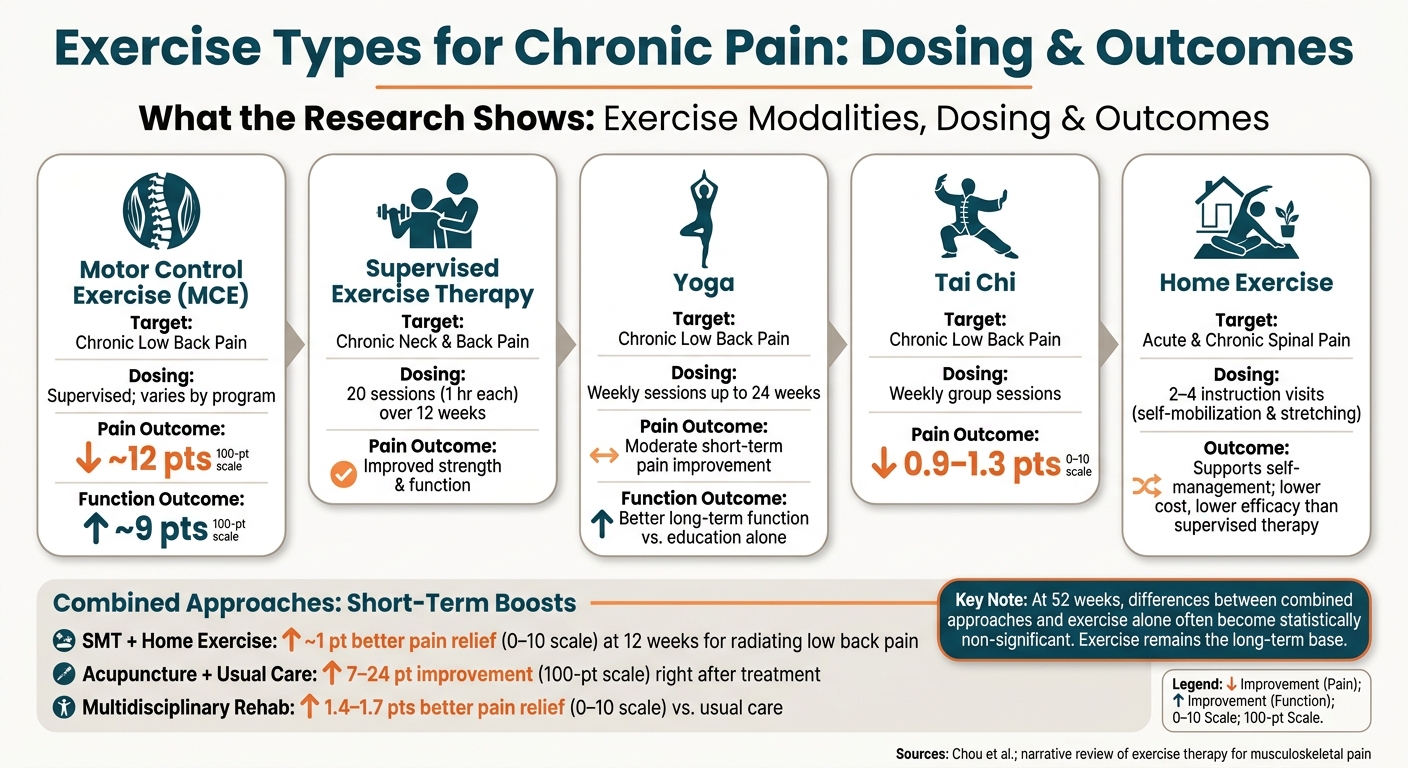
Exercise Types for Chronic Pain: Dosing, Conditions & Outcomes
Exercise doesn’t work the same way for every pain problem. Some people do best with walking and light aerobic work. Others get more from strength work, mobility, or a more guided program. The main issue isn’t only whether movement helps. It’s matching the type of exercise to the pain pattern and to how sensitive the person is right now.
Walking and Low-Impact Aerobic Exercise for Back Pain and General Conditioning
Walking and other low-impact aerobic exercise are practical starting points for chronic low back pain and for general conditioning. In many exercise therapy plans, a light aerobic warm-up of at least 10 minutes comes before strength or mobility work [1]. For a more structured plan, 20 one-hour supervised sessions over 12 weeks is a well-studied dosing model for chronic neck and back pain [1].
Strength Training and Mobility Work for Osteoarthritis, Tendinopathy, and Persistent Joint Pain
Motor control exercise (MCE) focuses on the deep spinal muscles. In the short term, it reduced pain intensity by about 12 points on a 100-point scale compared with minimal intervention [2]. Function improved too, by about 9 points on the same scale [2]. Yoga led to moderate short-term pain improvement and better long-term function compared with education alone [2]. Tai Chi trials found pain reductions of 0.9 to 1.3 points on a 0–10 scale versus no exercise [2].
Put simply, the pattern is fairly clear: different exercise types help different groups, and they tend to improve either pain, function, or both.
The tables below condense the main exercise types, dosing, and outcomes.
| Modality | Common Conditions | Typical Dosing | Main Outcomes |
|---|---|---|---|
| Motor Control Exercise (MCE) | Chronic low back pain | Supervised; varies by program | Pain improved by about 12 points on a 100-point scale; function improved by about 9 points on a 100-point scale [2] |
| Supervised exercise therapy | Chronic neck/back pain | 20 sessions (1 hr) over 12 weeks [1] | Improved strength and function [1] |
| Yoga | Chronic low back pain | Weekly sessions up to 24 weeks [2] | Moderate short-term pain improvement; better long-term function [2] |
| Tai Chi | Chronic low back pain | Weekly group sessions [2] | Pain reduction: 0.9–1.3 pts on a 0–10 scale [2] |
| Home exercise | Acute/chronic spinal pain | 2–4 instruction visits focused on self-mobilization and stretching [1] | Supports self-management; lower cost, lower efficacy than supervised exercise therapy [1] |
Exercise Combined with Dry Needling or Shockwave Therapy
Adding hands-on care or other add-on treatments to exercise can improve short-term results in some cases. For radiating low back pain, combining spinal manipulative therapy (SMT) with home exercise and advice led to about 1 point better pain relief on a 0–10 scale at 12 weeks compared with exercise alone [2]. Acupuncture added to usual care improved pain scores by 7 to 24 points on a 100-point scale right after treatment for chronic low back pain [2]. Multidisciplinary rehabilitation, which combines exercise with other nonpharmacologic care, beat single-modality physical therapy for short-term disability and pain [2].
There’s one catch. These gains often shrink with time. At 52 weeks, differences between combined approaches and exercise alone often become statistically non-significant [2]. So while add-on care can help in the short run, exercise remains the long-term base [2].
| Combined Care Approach | Target Condition | Main Outcomes |
|---|---|---|
| SMT + Home Exercise & Advice | Radiating low back pain | ~1 pt better pain relief (0–10 scale) at 12 weeks [2] |
| Multidisciplinary Rehabilitation | Chronic low back pain | 1.4–1.7 pts better pain relief (0–10 scale) vs. usual care [2] |
| SMT + Home exercise | Chronic neck pain (older adults) | Improved outcomes and lower costs vs. home exercise alone [1] |
| Acupuncture + Usual Care | Chronic low back pain | 7–24 pt improvement (100-point scale) right after treatment [2] |
The next section translates these patterns into starting points, pacing, and progression rules.
Matching Activity Type and Intensity to Your Pain Sensitivity
What matters most is your current pain sensitivity, not the exercise that looks best on paper. When joints feel touchy, they usually need a lower starting load. That’s because symptoms are shaped by how your system is reacting right now, not just by the type of exercise itself. From there, the goal is to match movement to what your body can handle today and how it responds day to day.
Starting Points for Low, Moderate, and High Pain Sensitivity
Use these as starting points, not fixed rules.
| Sensitivity Level | Starting Activity Options | Weekly Frequency | Progression Steps |
|---|---|---|---|
| High | Gentle mobility, water exercise, or Tai Chi [1][2] | 2–3 times/week [2][3] | Move toward gentle self-mobility work and gradually increase tolerance [1] |
| Moderate | Walking, Motor Control Exercise (MCE), or yoga [1][2] | 1–2 times/week [2] | Add complexity and light resistance as symptoms remain manageable [1][2] |
| Low | Strength training, aerobic conditioning, or supervised exercise therapy [1] | 3 times/week [3] | Increase reps first, then load [1][3] |
A simple way to think about it: start gentle, then build. Begin with easier movement, then work toward walking and strengthening as tolerance improves.
Simple Progression Rules for Walking, Strength, and Aerobic Exercise
Once you know where to start, keep progression simple. Increase reps first, then add load. With walking, add a little more time each session. With strength work, do more reps at a comfortable load before adding weight. Consistency beats any one workout.
When to Continue, Modify, or Scale Back Movement
Keep going when the activity stays manageable and daily function is stable or getting better. Pain flare-ups and day-to-day function help show whether the dose fits.
If an acute exacerbation occurs, switch to a lower-intensity or lower-velocity version of the movement instead of stopping completely [3]. In plain English, that could mean:
- using less resistance
- shortening the session
- simplifying the drill
Scale back and seek a clinical reassessment if progressive neurological deficits develop, or if pain seems tied to serious causes such as infection, inflammatory arthropathy, or trauma [2]. If pain is not improving by 30% to 50%, adjust the dose [2][3].
These dosing rules make it easier to pair movement with hands-on care and other wellness-based treatment.
Applying These Findings in Chiropractic and Wellness-Based Care
How Portland Chiropractic Group Pairs Hands-On Care with Graded Exercise

The next step is turning this research into a care plan people can actually follow. In chiropractic care, hands-on treatment can make early movement easier to handle. Then graded exercise helps build load tolerance that lasts. At Portland Chiropractic Group, care plans follow that order: lower sensitivity first, then progress movement over time.
For spinal pain, SMT often works as the starting point before a graded return to activity. For chronic low back pain, research shows a mean improvement of about 20 points on a 100-point pain and disability scale by 12 weeks. About 12 sessions is a common benchmark [3]. For back-related leg pain, adding SMT to a structured home exercise and advice program led to greater improvement in both leg and back pain at 12 weeks than home exercise and advice alone [2].
When pain or stiffness makes early movement hard, dry needling may be used as an add-on. Evidence shows drops in pain intensity of 7 to 24 points on a 100-point scale right after treatment for chronic low back pain [2]. The point isn’t passive relief by itself. It’s to help people move better between visits.
Here’s how common complaints line up with in-clinic care and movement work:
| Musculoskeletal Complaint | In-Clinic Service | Movement Focus |
|---|---|---|
| Chronic Low Back Pain | Spinal Manipulation | Motor control exercises and strength training; about 12 visits is a common benchmark [3] |
| Chronic Neck Pain | SMT + Supervised Exercise Therapy | Stretching and progressive resistance training |
| Back-Related Leg Pain | Spinal Manipulation + Home Exercise and Advice | Graded walking and structured home exercise |
| Tendinopathy / Joint Pain | Shockwave Therapy + Graded Strength and Conditioning | Graded strength loading and low-impact conditioning |
Conclusion: Key Points to Remember
Appropriate movement, matched to current sensitivity and progressed with care, can reduce stiffness, improve joint tolerance, and support pain management over time. Movement stays the base treatment, while hands-on care helps people shift into safer, more steady activity. The evidence supports hands-on care paired with structured exercise for chronic low back pain, chronic neck pain, and back-related leg pain [1][2][3].
FAQs
How much pain during exercise is okay?
Some discomfort during exercise can be normal, especially when you’re using movement to help a joint handle more load and feel less stiff. There isn’t one pain cutoff that works for everyone, so the goal is to match the type and intensity of activity to your current level of sensitivity.
Instead of avoiding movement altogether, aim for gradual progress. Small, steady challenges tend to support recovery better, and exercise is consistently shown to help manage musculoskeletal pain and improve function.
How do I know which type of exercise is right for my pain level?
Choose exercise based on what your pain seems to let you handle, and start with the easiest, lowest-intensity option.
A good place to begin is walking or light mobility work. As the joint becomes less sensitive, and you can finish a session without making symptoms worse, you can add stretching, strength work, or low-impact cardio.
The main thing is to let your response guide you. If an activity feels okay during and after the session, you can keep going or add a little more. If it ramps up your symptoms, dial it back and pick something simpler.
When should I stop exercising and get checked?
Stop exercising and get checked right away if movement leads to pain that keeps getting worse and doesn’t calm down, sharp or escalating joint pain, new or increasing weakness or numbness, pain that spreads along with nerve symptoms, fever or unexplained weight loss, or loss of bowel or bladder control.
You should also pause and get evaluated if you can’t do basic movements safely, or if pain still gets in the way of normal daily activities even after you reduce the intensity.
Related Blog Posts
- Joint Stability vs. Mobility: Key Differences
- Association between physical activity and risk of depression: A systematic review and meta-analysis
- Neuroimmune interactions in musculoskeletal conditions. An introduction for clinicians and patients
- Recent highlights in low back pain research, Part II: Prevention and management

Comments are closed